
13mm vs 16mm Pickleball Paddles: Which Thickness is Right for You?
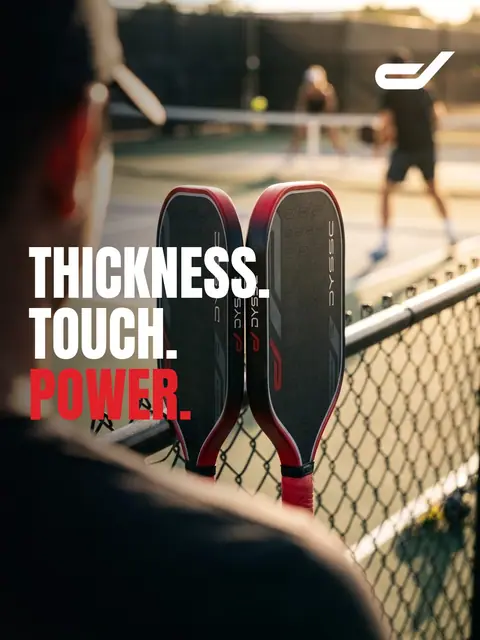
When players first start exploring premium paddles, they often focus on the face material or the shape. However, there is a hidden dimension that dictates how a paddle actually feels on contact: core thickness. In the modern game, the industry has standardized around two primary options: 13mm (thin) and 16mm (thick).
Choosing between a 13mm and 16mm core isn't just a matter of preference; it is a tactical decision that affects your power, your reset capability, and your 'hand speed' at the kitchen. If you have already read our guide on Pickleball Paddle Weight, Thickness & Grip Size, you know the basics. Today, we are diving deep into the performance science to help you decide which thickness will elevate your game.
The Science of Core Thickness
At the heart of almost every modern paddle is a polymer honeycomb core. The thickness of this core determines how much energy is absorbed when the ball strikes the paddle and how much is returned to the ball.
A thinner core (13mm) is more rigid. Because there is less material to compress, the ball spends less time on the face of the paddle (dwell time). This results in a higher energy return—commonly known as 'pop' or 'power.'
A thicker core (16mm) acts like a cushion. It compresses more upon impact, absorbing the ball's energy. This increases the dwell time, allowing the player to feel the ball better and manipulate it with more precision. This is why 16mm paddles are universally recognized as 'control' paddles.
The 16mm Core: Stability and the Soft Game
The 16mm core is currently the most popular choice for professional players and serious club players in India. Paddles like the DYSSC HexCore Pro utilize a 16mm thickness to provide a dampening effect that is essential for high-level play.
Benefits of 16mm:
- Larger Sweet Spot: Thicker cores generally offer more edge-to-edge stability. If you hit the ball slightly off-center, a 16mm paddle is less likely to twist in your hand, resulting in fewer 'dead' shots.
- Superior Resets: When an opponent smashes a ball at you, a 16mm core absorbs that pace, making it significantly easier to drop the ball softly into the kitchen.
- Consistency in Dinking: Because the paddle is less 'bouncy,' you have more margin for error during delicate kitchen rallies. You don't have to worry about the ball flying off the face unexpectedly.
If your game relies on strategy, patience, and waiting for the right moment to strike, a 16mm paddle is your best ally.
The 13mm Core: Speed and Aggression
While 16mm is about control, 13mm (and sometimes 14mm) is about pure aggression. These paddles are thinner, which often makes them more aerodynamic and slightly lighter in the head.
Benefits of 13mm:
- Increased Hand Speed: Because they move through the air with less resistance, 13mm paddles allow for faster reactions during 'firefights' at the net.
- Effortless Power: You don't need a massive swing to generate depth. The rigidity of the thin core does the work for you, making it easier to put away high balls or drive from the baseline.
- Feedback: Some players prefer the 'stiff' feel of a thin paddle, as it provides more vibration and immediate feedback on exactly where the ball hit the face.
However, the trade-off is a smaller sweet spot and a 'hotter' face that can make dinking more difficult for beginners. If you are still learning the basics, you might find our How to Choose Your First Pickleball Paddle guide helpful before committing to a thin, aggressive paddle.
Which Thickness Suits Your Playstyle?
Choosing the right thickness requires an honest assessment of your strengths and weaknesses on the court.
Choose 16mm if:
- You prioritize 'The Third Shot Drop' and a strong soft game.
- You want to reduce unforced errors and maximize your sweet spot.
- You have plenty of natural power and don't need the paddle to help you hit harder.
- You play mostly doubles where the dink battle is frequent.
Choose 13mm if:
- You play high-level singles and need maximum 'pop' to finish points.
- You have a very fast swing and want a paddle that keeps up with your hand speed.
- You struggle to generate depth from the baseline and need more power assistance.
- You prefer a 'stiff' feeling and don't mind a less forgiving sweet spot.
The Impact of Indian Playing Conditions
In India, we often play in high humidity or on outdoor courts where the heat can make the ball feel 'mushy.' In these conditions, a 16mm paddle like the DYSSC HexCore Pro is often preferred because it provides the necessary stability to control a ball that might be behaving unpredictably due to the weather.
Furthermore, many Indian courts are constructed with slightly slower surfaces. A 16mm paddle allows you to engage in the long dinking rallies that are common on these courts without the risk of accidentally popping the ball up for an opponent's smash.
Final Verdict
If you are an intermediate to advanced player looking to stabilize your game and master the transition zone, the 16mm core is the gold standard. It provides the 'plush' feel required for professional-level touch and resets. However, if you are a power hitter who lives for the 'bang,' the 13mm or 14mm options offer the aerodynamic speed you crave.
Most elite players eventually land on a 16mm carbon fiber paddle because, at the highest levels of pickleball, control wins more games than raw power. By choosing a paddle with a premium 16mm core, you are investing in a tool that rewards technique and tactical precision.
Frequently asked questions
Does a 16mm paddle weigh more than a 13mm paddle?
Not necessarily. Weight is determined by the materials and the density of the core, not just the thickness. A 16mm paddle can be made light (7.8oz) or heavy (8.5oz) depending on the manufacturer's design.
Which thickness is better for tennis players moving to pickleball?
Tennis players often have a lot of natural power but struggle with the 'soft' aspect of pickleball. A 16mm paddle is usually better as it helps them develop a touch game and prevents them from over-hitting the ball.
Can I still hit hard with a 16mm paddle?
Absolutely. High-end 16mm paddles like the DYSSC HexCore Pro use advanced carbon fiber surfaces to ensure you still have plenty of power for drives and overheads while maintaining superior control.
Keep reading
Comments (0)
Be the first to comment.