
When to Replace Your Pickleball Paddle: Dead Spots, Delamination and Core Crush
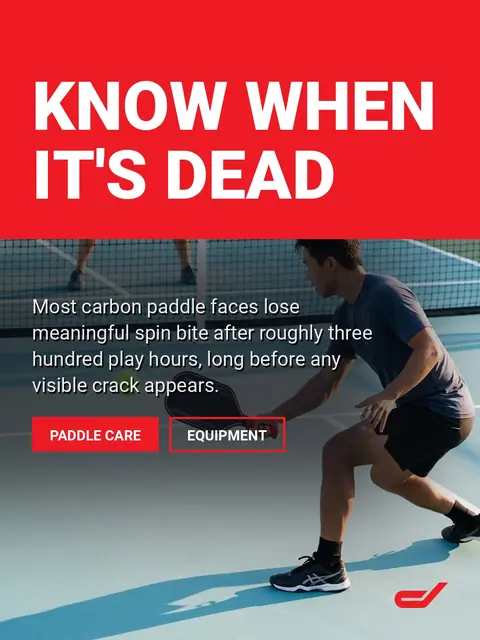
Nobody replaces a paddle because it broke. Paddles almost never break. They fade — slowly, over months — until one day your third-shot drop floats, your dinks sit up, and you assume you're in a slump. You're not. Your paddle is dead and you're the last person to know.
Here is how to tell the difference between a bad week and a finished paddle.
Paddles Fail in Four Ways
1. Core crush (dead spots). The polypropylene honeycomb core under the face is a grid of tiny cells. Every hard hit compresses them slightly. In the sweet spot, where you make contact thousands of times, those cells eventually stay compressed. The result is a soft, muffled patch that absorbs energy instead of returning it. Your drives land short by half a metre and you swing harder to compensate.
2. Delamination. The face separates from the core, usually near the top or edges. Early on this actually makes the paddle hit harder and sound hollow — which is why delaminated paddles are banned in sanctioned play. Later it becomes wildly inconsistent: one ball rockets, the next dies.
3. Face wear. Raw carbon and textured surfaces generate spin through friction. That grit polishes down with use, and faster if you play on gritty outdoor concrete. You lose spin before you lose power, which is why your topspin roll suddenly stops dipping.
4. Edge guard and grip failure. The cheapest fixes, and the ones people ignore. A lifting edge guard lets moisture into the core. A slick grip changes your grip pressure, which quietly wrecks touch shots.
Three Tests You Can Do Today
- The bounce map. Drop a ball from about a metre onto five spots on the face: centre, above centre, both sides, and near the throat. A healthy paddle gives a consistent rebound and a consistent sound. If the centre bounces noticeably lower or sounds duller than the shoulders, your core is crushed.
- The tap test. Flick your fingernail slowly across the face in a grid. You are listening for a change in pitch — a hollow, rattly, or buzzy zone means the face has separated from the core underneath.
- The thumbnail test. Run your thumbnail across the hitting surface, then across an unused corner near the throat. If the corner feels rough and the middle feels smooth, your spin surface is gone.
If you fail the tap test, stop using that paddle in competitive or rated play. Delaminated paddles are not a grey area — they're illegal, and the tournament desk will hear it in the sound.
So How Long Should a Paddle Last?
Forget calendars, count hours. Realistic ranges for a quality carbon-face paddle:
- Casual player, 2 hours a week: 18-24 months
- Regular club player, 4-6 hours a week: 10-14 months
- Competitive player drilling and playing 10+ hours a week: 4-8 months
- Bangers and heavy topspin players: knock 20-30% off the above
Heavy topspin players wear faces out fastest because they're grinding the ball across the surface, not just striking it. Players who hit flat and hard crush cores faster.
What Indian Courts Do to Your Paddle
Conditions here accelerate every failure mode. Court surfaces are often rougher broom-finished concrete rather than cushioned acrylic, and every scrape of a low volley or ATP attempt sands your edge guard and face. Coastal humidity in Mumbai and Chennai works into any gap in the edge guard. Car boots in a Delhi summer regularly cross 60°C, which is enough to soften adhesives over a season — never store a paddle in a parked car, and never leave it face-up in direct sun between games. Basic maintenance genuinely buys you months; our guide on how to clean and care for your pickleball paddle covers the routine.
Replace, or Upgrade?
If your paddle is dead, don't buy the same one out of habit. A dying paddle is the cheapest excuse you'll ever get to fix a mismatch you've been playing around. Ask:
- Are you constantly late on hand battles? You want a lower swing weight.
- Are your drops floating even on fresh equipment? You want a thicker, softer core.
- Are you losing pop in the kitchen exchanges? A thermoformed, foam-walled build helps.
The carbon fibre versus foam paddle comparison is a good starting point, and if you want a shortlist that's actually relevant to what ships here, our roundup of the best pickleball paddle in India is built for local availability and pricing, not US retail stock.
The DYSSC HexCore Pro is built for this specific problem: a raw carbon face for durable grit, a heat-sealed edge that resists moisture ingress, and a honeycomb core density chosen to resist crush at competitive hit volumes. It's USAPA-approved, so it's legal the day you buy it and it stays legal as long as it passes the tap test.
Get Two Paddles Sooner Than You Think
Serious players rotate. Keep your newest paddle for tournaments and rated play, and demote the older one to social sessions and drilling. It doubles your effective lifespan and it means you're never showing up to a match having played three sets with an unfamiliar face. As pickleball in India becomes more competitive and more DUPR-rated, the difference between a fresh paddle and a nine-month-old one is measurable in matches, not just in feel.
Your paddle is the only piece of equipment that touches every single ball. Test it monthly. Replace it before it costs you a game you should have won.
Frequently asked questions
How do I know if my pickleball paddle is delaminated?
Tap your fingernail across the face in a grid and listen for a change in pitch. A hollow, buzzy or rattly zone means the face has separated from the core. Delaminated paddles are illegal in sanctioned play and should be retired immediately.
Does a pickleball paddle really lose power over time?
Yes. The honeycomb core cells under the sweet spot compress permanently after thousands of impacts, creating dead spots that absorb energy instead of returning it. Drives and drops start landing short even though your technique hasn't changed.
How often should a club player replace a paddle in India?
At 4-6 hours of play per week, expect 10-14 months. Rough concrete surfaces, humidity and heat storage shorten that, so run the bounce and tap tests monthly rather than relying on the calendar.
Keep reading
Comments (0)
Be the first to comment.