
Swing Weight and Twist Weight Explained: The Paddle Specs Nobody Tells You About
You pick up two paddles. Both say 8.0 oz on the spec sheet. One feels like a feather in hand battles, the other feels like you're swinging a frying pan. Nothing on the box explains it.
The answer is that static weight — the number on a kitchen scale — is the least useful spec in pickleball. What you actually feel is swing weight and twist weight, and once you understand those two numbers you will never shop for a paddle the same way again.
What Swing Weight Actually Measures
Swing weight is how heavy the paddle feels while it is moving. It measures how mass is distributed along the length of the paddle, not how much mass there is. Weight concentrated near the tip is far away from your wrist, so it takes more effort to accelerate and more effort to stop.
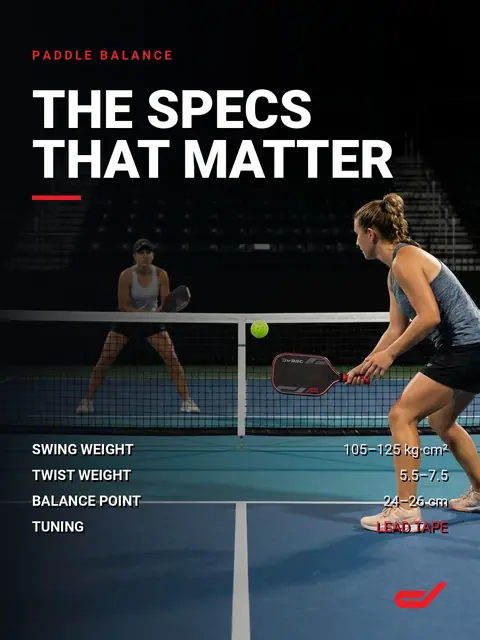
It is expressed in kg·cm² and most modern 16mm paddles land between 105 and 125.
- Low swing weight (below 110): lightning hand speed at the kitchen, easy resets, less free power. Good for doubles specialists who live in hand battles.
- Mid swing weight (110–118): the sweet spot for most players. Enough plow-through to drive, quick enough to counter.
- High swing weight (118+): big put-aways, heavy drives, deep serves — but you will be late on speed-ups and your shoulder will feel it in the third game.
Here is the part that trips people up: a 7.9 oz head-heavy paddle can have a higher swing weight than an 8.4 oz handle-heavy paddle. Static weight and swing weight move independently. This is why buying by ounces alone is guesswork.
Twist Weight: The Stability Spec
Twist weight measures resistance to rotation when you hit the ball away from the centre of the face. Mishit toward the edge and a low-twist-weight paddle turns in your hand — the ball dies, sprays wide, or pops up. A high-twist-weight paddle stays square and the ball still goes somewhere useful.
- Typical range is 5.5 to 7.5.
- Below 6.0 feels precise but punishing on off-centre contact.
- Above 6.8 gives you a genuinely forgiving paddle — the closest thing to a bigger sweet spot.
Twist weight is driven by width and perimeter mass. Wider paddles and paddles with weight in the edge foam or edge guard resist twisting better. Long, narrow shapes give you reach and swing weight but sacrifice stability. That's the trade-off nobody prints on the box.
If you play in windy outdoor conditions or against players who target your hip and shoulder, twist weight matters more to your win rate than raw power ever will.
Balance Point: The Third Number
Balance point is measured in centimetres from the butt cap. On a standard 16-inch paddle:
- Under 24 cm: handle-heavy, whippy, very manoeuvrable.
- 24–26 cm: neutral, what most stock paddles ship as.
- Over 26 cm: head-heavy, more mass behind contact, slower to reverse direction.
Balance point is the lever that connects static weight to swing weight. Same weight, moved further from your hand, equals a heavier swing.
How to Tune Your Paddle Yourself
You do not need a new paddle to change how yours feels. Lead tape (or tungsten tape) costs almost nothing and each strip is roughly 0.25 g per inch.
- Want more power and stability without losing hand speed: put tape at 3 and 9 o'clock (the widest points of the face). This raises twist weight a lot and swing weight only a little. Best value change available.
- Want more plow-through on drives and overheads: tape at 12 o'clock. Raises swing weight fast. Add 4 g and you will feel it immediately.
- Want a heavier paddle that still feels quick: add lead under the grip or inside the butt cap. Raises static weight, lowers balance point, barely touches swing weight.
- Change one variable at a time, and play two full sessions before deciding. Your hands adapt within about twenty minutes, so first impressions lie.
Rebuild your overgrip after any handle work — grip thickness changes your wrist mechanics, which we cover in the paddle weight, thickness and grip size guide.
What This Means for Indian Players
Court and climate matter here. Most play in pickleball in India happens on hard acrylic or converted badminton surfaces in real heat, often across long social sessions of three or four hours. A high-swing-weight paddle that feels great for twenty minutes becomes an elbow problem by hour three. Sweat also adds effective handle mass over a session, so a paddle that starts neutral drifts handle-heavy.
Practical guidance: start lower on swing weight than you think you need, then add tape. Subtracting weight from a paddle is nearly impossible; adding it takes thirty seconds.
The DYSSC HexCore Pro is built around a mid-110s swing weight and a wide face for high twist weight, which is deliberately the most tunable starting point — quick enough to counter, stable enough to mishit, and with room to add tape in either direction. If you are comparing options, our breakdown of the best pickleball paddle in India lists these numbers instead of hiding them.
Pair this with the 13mm vs 16mm thickness guide and you have the full picture: core thickness sets feel, swing weight sets speed, twist weight sets forgiveness. Three numbers. That's the whole spec sheet that matters.
Frequently asked questions
Is swing weight more important than paddle weight?
Yes. Static weight only tells you what the paddle weighs at rest, while swing weight tells you how heavy it feels in motion — which is what determines your hand speed, drive power and shoulder fatigue. Two paddles at the same ounces can differ by 15 points of swing weight and feel like completely different tools.
How much lead tape can I safely add to a pickleball paddle?
Most players add 4 to 8 grams total without issues. Keep it inside the edge guard or on the face just inside the perimeter, apply it symmetrically on both sides of the paddle so you do not create a twist bias, and check that total paddle weight stays within any tournament or manufacturer limits.
Keep reading



Comments (0)
Be the first to comment.