
Hand Battles in Pickleball: When to Speed Up and How to Win the Counter
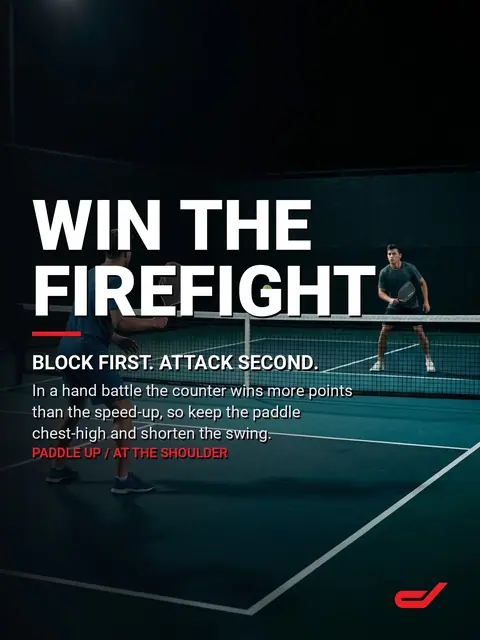
Watch any 4.0-plus doubles game and count how points actually end. Very few finish with a clean winner off a dink. Most end in a hand battle — a two- to five-ball firefight at the net that starts the instant somebody speeds the ball up.
Which means the players who win the most games are not the ones with the softest hands or the hardest drives. They are the ones who pick the right ball to attack, and who do not panic when the ball comes back at them at 60 km/h.
What a Speed-Up Actually Is
A speed-up is a deliberate acceleration out of a soft exchange — turning a dink rally into a firefight on your terms. The key word is deliberate. A speed-up you chose is an attack. A speed-up you were forced into is a gift to the other team.
The trigger is almost never power. It is timing plus target. You are not trying to hit through your opponent; you are trying to arrive before their paddle does.
The Three Green Lights
Only attack when at least one of these is true:
- The ball is above the net tape. Anything you have to lift is a low-percentage attack. If the contact point is below the tape, dink it again and wait.
- Your opponent's paddle is down or drifting. After a stretched-out dink, most players let the paddle tip drop toward the ankles. That is a half-second window where they cannot counter.
- Your opponent is moving or leaning. A player shifting weight sideways cannot fire a two-handed counter. Attack into the direction they are travelling away from.
Red lights are just as important. Do not speed up off a ball at your shoelaces, do not speed up when you are the one off balance, and do not speed up cross-court on the first ball — that long diagonal gives the defender time to load up.
Where to Aim
Beginners aim at open court. Advanced players aim at the body, because a body target reduces the opponent's paddle options.
The best three targets, ranked:
- The dominant shoulder / hip. The hardest place to get a paddle to. For a right-hander, that is their right shoulder.
- The right hip pocket of the player whose paddle is on the left. It forces a jam and usually a pop-up.
- The middle seam in doubles, but only when both opponents are shifted wide. Middle balls create hesitation.
Aim flat and low, not down. Trying to hit down over a 34-inch net from seven feet away is how balls end up in the tape. Drive through the ball with a compact swing and let topspin bring it down.
How to Win the Counter
Here is the uncomfortable truth: at every level above 3.5, the counter wins more points than the speed-up. Defence is the profitable half of the hand battle.
- Paddle up, in front, at chest height. If your paddle tip is below your wrist when the ball is fired, you have already lost the exchange.
- No backswing. Counters are blocks and short punches. Your opponent has supplied the pace; you only supply the angle.
- Counter down the middle or back at the attacker's shoulder. Do not try to redirect a 60 km/h ball into a sideline. Low risk, high return.
- Reset when you are late. If the ball beats your hands, absorb it with a soft chest-high block into the kitchen. This is the same skill you build in the reset shot — a loose grip and a giving wrist.
- Breathe out and stay square. Turning sideways in a firefight shrinks your reach. Keep the chest facing the ball.
One more rule: never take your eyes off the paddle. In a hand battle, information comes from the opponent's contact point, not the flight of the ball. You simply do not have time to react to flight alone.
Drill It, Don't Hope for It
Two drills that transfer directly to match play:
- Trigger dinks. Cross-court dinks only, both players allowed to speed up any ball above the tape. Play to 11. This teaches selection more than any amount of talking.
- Firefight feeds. Partner stands at the kitchen line and fires four medium-pace balls at your body in a row. Your only job is to block all four back below net height. Three sets of ten.
Both drills build directly on the patience you developed in dinking strategy — a good hand battle player is a good dinker who knows exactly when to stop dinking.
Does the Paddle Matter Here?
More than anywhere else on the court. Hand battles reward swing weight and face stability over raw power. A head-heavy, high-swing-weight paddle simply cannot get from a dink position to a counter position in time. What you want is a stable, mid-swing-weight paddle with a raw carbon face that grips the ball on quick blocks so counters do not fly long.
That is exactly the brief for the DYSSC HexCore Pro — a USAPA-approved raw carbon face with a balanced swing weight, built for players who live at the kitchen line. If you are comparing options, our breakdown of the best pickleball paddle in India covers how swing weight changes hand speed.
As pickleball in India matures and league play gets faster, hand battles are becoming the deciding skill in local tournaments. Learn the green lights, drill your blocks, and you will start winning the exchanges everyone else survives by luck.
Frequently asked questions
Is it legal to speed up a ball from inside the kitchen?
Yes, as long as the ball has bounced first and you are not volleying it. You can stand in the non-volley zone and hit a bounced ball as hard as you like; you may only not volley the ball out of the air while touching the kitchen or its line.
Should beginners speed up at all?
Sparingly. Below 3.0, most speed-ups come off balls below the net tape and simply hand over the point. Learn to dink patiently first, then add speed-ups only on balls you can contact above net height with your paddle already in front of you.
Keep reading
Comments (0)
Be the first to comment.