
Mastering the Reset Shot: How to Neutralize Fast Play in Pickleball
The Ultimate Equalizer: Understanding the Reset Shot
In the fast-paced world of modern pickleball, especially as the game gains massive popularity across India, players are hitting the ball harder than ever. If you have spent any time on a competitive court, you have likely faced 'bangers'—players who rely on sheer power and high-velocity drives to overwhelm their opponents. To survive and thrive against this style of play, you must master the reset shot.
A reset is a defensive shot hit from the midcourt (the 'transition zone') or the baseline that lands softly in the opponent's kitchen. The goal is simple: take all the pace off an aggressive ball and force your opponent into a slow-paced dinking battle. It is the bridge that allows you to move from a position of weakness to a position of neutral parity at the net.
Why the Reset is Critical for Intermediate Players
Many players transitioning from tennis or badminton to pickleball struggle with the 'soft game.' The instinct is often to fight fire with fire—hitting a hard ball back even harder. However, when you are caught in the transition zone (halfway between the baseline and the kitchen), swinging hard usually results in the ball flying out of bounds or into the net.
The reset shot allows you to 'neutralize' the point. By dropping the ball into the non-volley zone, you take away your opponent’s ability to hit downward at your feet. Mastering this shot is what separates a recreational player from a tournament-ready competitor. It requires a combination of composure, 'soft hands,' and the right equipment to absorb energy.
The Mechanics of a Perfect Reset
Performing a reset is less about what you do with your arm and more about what you don't do. Unlike a drive or a serve, a reset requires minimal movement. Here is the technical breakdown of how to execute it consistently.
1. Light Grip Pressure
Grip pressure is the most important factor in a successful reset. On a scale of 1 to 10, where 10 is a death-grip and 1 is barely holding the paddle, your reset grip should be around a 3 or 4. A loose grip allows the paddle to act like a shock absorber, soaking up the speed of the incoming ball. If your grip is too tight, the ball will bounce off the paddle face like it's hitting a brick wall, likely popping up for an easy smash for your opponent.
2. The 'Wall' Technique
Think of your paddle as a wall, not a racket. Your goal is to let the ball hit the paddle rather than you hitting the ball. Keep your paddle out in front of your body with a short, compact backswing—or better yet, no backswing at all. Use your legs to get low, ensuring your paddle face is angled slightly upward to guide the ball over the net.
3. Contact Point
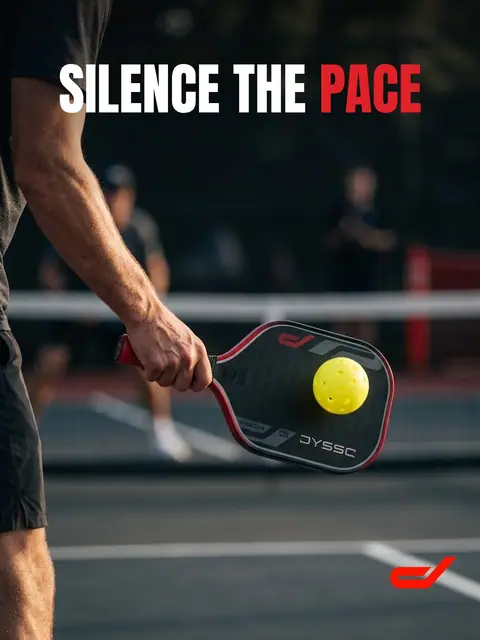
Always try to meet the ball well in front of your body. If you let the ball get behind your hips, you lose control over the trajectory. By meeting the ball early, you can use the paddle’s surface to 'cushion' the impact. This is where high-quality gear makes a difference; the DYSSC HexCore Pro is designed with a Toray T700 Carbon Fiber face that provides the vibration dampening and 'dwell time' needed to feel the ball and guide it accurately into the kitchen.
When to Use the Reset
The reset is not just a desperation move; it is a strategic choice. You should look to reset in the following scenarios:
- When You are Caught in 'No Man’s Land': If you hit a return and are sprinting toward the kitchen but get caught halfway, do not try to hit a winner. Hit a reset to buy yourself time to finish your walk to the line.
- During a Firefight: If your opponents are slamming volleys at you from the kitchen line, a sudden soft reset can catch them off guard, forcing them to reach down and lift the ball, which gives you the advantage.
- After a Poor Third Shot: If your third-shot drop was too high and your opponent is about to attack it, prepare for a reset to fix the mistake and keep the point alive.
Drills to Improve Your Reset
To master this, you need to build muscle memory for absorbing pace. Here are two effective drills:
The 'Wall' Drill (Solo): Stand about 5-7 feet from a wall. Hit the ball hard against the wall, and on the rebound, try to hit a soft 'reset' that lands just at the base of the wall. This teaches you how to quickly adjust your grip pressure from firm to soft.
The Transition Drill (With a Partner): Have your partner stand at the kitchen line while you start at the baseline. Have them hit aggressive, downward volleys at you. Your goal is to hit a reset into their kitchen. Once you hit a successful reset, take two steps forward. Repeat this until you reach the kitchen line. For more ideas on structured practice, check out our guide on pickleball drills to improve fast.
Gear Matters: Control vs. Power
While skill is paramount, your paddle's core construction significantly affects your ability to reset. Thinner paddles tend to be 'poppy' and harder to control for defensive shots. A 16mm thick paddle, like the DYSSC HexCore Pro, offers a more stable platform and a larger sweet spot, making it much easier to deaden the ball's energy.
When the ball is coming at you at 60 km/h, the honeycomb core and carbon fiber surface work together to provide the tactile feedback required to place the ball exactly where you want it. In the high-heat environments of Indian outdoor courts, having a paddle that maintains its structural integrity and control is vital for a consistent defensive game.
Conclusion
The reset shot is arguably the most 'unselfish' shot in pickleball. It doesn't look flashy, and it rarely ends the point immediately, but it is the foundation of winning strategy. By learning to embrace the soft game and using the reset to neutralize aggressive opponents, you turn their greatest strength—their power—into a non-factor. Combined with a solid dinking strategy, the reset shot will transform you into a formidable player on any court in India.
Frequently asked questions
What is the difference between a dink and a reset?
A dink is a soft shot hit when both players are already at the kitchen line. A reset is a defensive shot hit from the midcourt or baseline specifically to neutralize a fast, aggressive ball and drop it into the kitchen.
How can I stop popping up my resets?
Popping up usually happens because of too much grip pressure or too much paddle movement. Relax your hand (aim for a 3/10 grip pressure) and keep your paddle face steady without swinging.
Does paddle thickness affect the reset shot?
Yes. Thicker paddles (like 16mm) generally absorb more energy and provide better control for resets compared to thinner 'power' paddles (11mm-13mm) which tend to be more bouncy.
Keep reading
Comments (0)
Be the first to comment.