
The Pickleball Punch Volley: Mastering Aggressive Kitchen Play
The Pickleball Punch Volley: Mastering Aggressive Kitchen Play
In the fast-paced world of pickleball, the kitchen line is where games are won or lost. While the dink is the foundation of a solid short game, relying solely on defensive drops will eventually leave you vulnerable to aggressive opponents. To move from a recreational player to a competitive threat, you must master the punch volley.
The punch volley is the middle ground between a soft dink and a full-blooded overhead smash. It is a compact, aggressive stroke used to punish balls that are left slightly too high or too slow in the non-volley zone. When executed correctly, it forces errors, sets up put-aways, and keeps your opponents on their heels.
What is a Punch Volley?
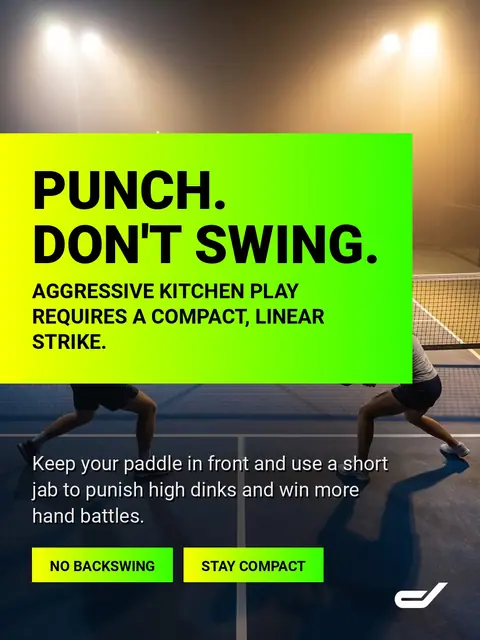
Unlike a groundstroke, the punch volley requires almost no backswing. It is a linear, pushing motion where the power comes from your weight transfer and a short, crisp contact. Think of it as a "jab" in boxing rather than a haymaker. The goal isn't necessarily to hit the ball through the opponent, but to hit it at them with enough pace and depth to disrupt their rhythm.
In the context of pickleball in India, where courts are often fast and outdoor conditions can be unpredictable, the punch volley is an essential tool for neutralizing the "banger" and taking control of the point.
The Mechanics of the Perfect Punch
To execute a consistent punch volley, you must prioritize stability over swing speed. Follow these four pillars of technique:
- The Short Backswing: This is the most critical element. Your paddle should never go behind your shoulder. If you take a large backswing at the kitchen, you lose time and accuracy. Keep the paddle in your peripheral vision at all times.
- Paddle Face Control: For most punch volleys, you want a neutral or slightly closed paddle face. This ensures the ball travels on a downward or flat trajectory, preventing it from sailing long.
- The "Push" Motion: Instead of swinging, imagine you are pushing a heavy door shut. Use your shoulder and elbow to guide the paddle forward through the ball.
- Grip Pressure: Maintain a medium grip pressure (about a 5 or 6 out of 10). Too tight, and you lose feel; too loose, and the paddle will twist on off-center hits. A stable paddle like the DYSSC HexCore Pro is specifically designed to handle these high-impact shots without vibrating in your hand.
When to Use the Punch Volley
Recognizing the right ball to punch is just as important as the technique itself. If you try to punch a ball that is below the net height, you will likely hit it into the tape. Look for these opportunities:
- The Dead Dink: If your opponent hits a dink that sits up above net height and lacks significant spin, it’s an invitation to punch. Aim for their feet or their backhand hip.
- The Chest-High Speed Up: If an opponent attempts a hand battle and hits the ball toward your chest, don't just block it back. Use a compact punch to redirect their power.
- The Transition Catch: If you catch your opponents moving up to the kitchen, a deep punch volley to their feet will stop their momentum and force a defensive popup.
Placement: Where to Aim
Power is useless without placement. When you have the opportunity to punch, target these three high-percentage areas:
- The Chicken Wing: Aim for the opponent's dominant shoulder (right shoulder for right-handed players). This is the hardest spot to defend because it forces the player to cramp their arm to make contact.
- The Feet: Aiming at the shoelaces is the safest aggressive play. It is incredibly difficult to lift a fast, low ball back over the net while maintaining control.
- The Gap: In doubles, a punch volley directed right between the two players often causes a communication breakdown. Even if they get it back, the return is usually weak.
Choosing the Right Gear
The effectiveness of your punch volley is heavily influenced by your paddle’s "pop" and stability. If your paddle is too soft, your punches will lack the finishing pace needed to win points. If it’s too "hot," you might struggle with mastering the backhand dink because the ball flies off the face too quickly.
The best pickleball paddle in India for this style of play is one that offers a balance of thermoformed power and a large sweet spot. The DYSSC HexCore Pro excels here; its Toray T700 carbon fiber face provides the grit for spin-heavy punches, while the foam-injected edges ensure that even off-center volleys stay on target.
Common Mistakes to Avoid
- Wrist Flicking: Many players try to generate power by snapping their wrist. This leads to wild inconsistency. Keep the wrist firm and let the arm and body do the work.
- Over-Hitting: You don't need 100% power. A 70% power punch with 100% accuracy is far more effective than a blast that hits the back fence.
- Standing Tall: Stay in an athletic crouch. If you stand straight up, your eyes are further from the ball, making it harder to track and time the punch.
Drills for the Punch Volley
To build muscle memory, try the Volley-to-Volley Drill. Stand at the kitchen line with a partner and hit volleys back and forth. Start soft, then gradually increase the pace of one out of every three balls. Focus on keeping your paddle out in front and minimizing your take-back. As you get comfortable, focus on redirecting the ball to different targets without changing your swing speed.
By incorporating the punch volley into your arsenal, you transition from a passive defender to a proactive playmaker. It’s the difference between waiting for your opponent to make a mistake and forcing them to make one.
Frequently asked questions
What is the difference between a punch volley and a block?
A block is a defensive move designed to absorb the opponent's power and drop the ball short. A punch volley is an offensive move where you add your own pace and direction to the ball to pressure the opponent.
Can I use a punch volley from the baseline?
No. The punch volley is specifically a kitchen-line (non-volley zone) technique. From the baseline, you would use a full groundstroke drive to generate the necessary depth.
Why is my punch volley going into the net?
This usually happens if you are hitting a ball that is too low or if your paddle face is angled downward too much. Only punch balls that are at or above net height.
Keep reading
Comments (0)
Be the first to comment.