
Defending the Smash in Pickleball: Tactics to Survive the Overhead
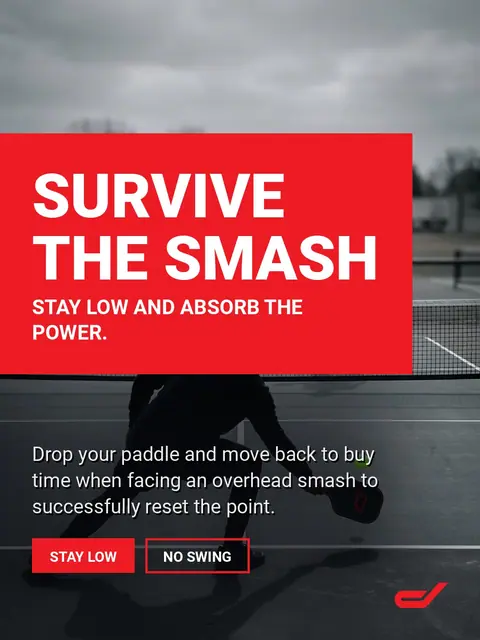
The Art of Survival: Turning Defense into Offense
In the rapidly growing world of pickleball in India, many players transition from badminton or tennis backgrounds. This brings a high level of aggression to the court, specifically in the form of the overhead smash. If you find yourself frequently on the receiving end of a thunderous hit, you know the feeling of helplessness as the ball zips past you.
However, a smash is not a guaranteed point for your opponent. With the right technique, a calm mind, and the right equipment—like the vibration-dampening DYSSC HexCore Pro—you can neutralize these attacks and reset the point. Defending a smash is about physics, positioning, and psychological resilience.
Step 1: Buy Yourself Time with Depth
The biggest mistake players make when they see a high ball is freezing or, worse, moving toward the net. Unless you are in a position to poach the ball mid-air, your best friend is distance. As soon as you realize your team has popped the ball up, you must retreat. Moving two or three steps behind the baseline gives the ball more time to slow down after it bounces, making it significantly easier to track.
In doubles, communication is key. If you are lobbed or hit a poor drop that sits up, both partners should move back in unison. This creates a defensive wall. When you have the best pickleball paddle in India in your hand, its surface area and stability help you block these high-velocity shots without the paddle twisting in your grip.
Step 2: The Defensive Stance (Stay Low)
High balls are defended from a low position. You want your center of gravity to be closer to the ground. This allows you to spring in any direction and ensures your paddle is already under the likely trajectory of the ball.
Key components of the defensive stance:
- Feet wide: Keep your base wider than shoulder-width for maximum stability.
- Paddle out front: Do not tuck your paddle into your chest. Keep it out in front of your body with a relaxed grip.
- Weight on balls of feet: Avoid being 'flat-footed,' which makes it impossible to react to angled smashes.
Step 3: The 'Soft Hands' Block
The natural instinct when a ball is coming at you fast is to swing back at it. This is a recipe for disaster. A swing adds more energy to an already fast ball, usually resulting in it flying long or into the net. Instead, think of your paddle as a shield. Your goal is to let the ball hit the paddle and simply 'absorb' the energy.
Loosen your grip pressure—aim for a 3 or 4 out of 10. This creates a 'trampoline effect' in reverse, where the paddle face eats the speed of the ball, allowing it to drop softly back over the net. This is known as a master-pickleball-reset-shot.
Step 4: Angle the Paddle Face
If you just hold the paddle flat, the ball will likely bounce straight up, giving your opponent an even easier second smash. To truly defend effectively, you must angle the paddle face slightly upward and toward the kitchen. The goal is to land the ball in the non-volley zone (NVZ). Even if the ball is hit at your feet, a slightly open paddle face will lift it over the net and force the 'smasher' to come in and hit a dink, effectively neutralizing their power advantage.
Step 5: Anticipate the Angle
Most smashes aren't hit directly at you; they are hit at your feet or into the open 'middle' of the court. Watch your opponent's shoulders and paddle face. If they are leaning back and their paddle is angled toward your partner’s feet, start shading that way early. Learning who takes the middle ball in pickleball doubles is crucial here so you don't clash paddles while trying to defend the same smash.
Psychological Warfare: Frustrating the Smasher
There is nothing more frustrating for an aggressive player than hitting a perfect smash only for it to be returned as a soft dink. If you can return two or three smashes in a single rally, your opponent will start trying to hit the ball harder or closer to the lines, which leads to unforced errors. Defensive excellence is a mental weapon. While they are focusing on mastering-pickleball-overhead-smash-technique, you are focusing on making those smashes irrelevant.
Gear Matters: Stability and Control
Defending high-speed shots requires a paddle with a high 'twist weight'—meaning it doesn't rotate when hit off-center. The HexCore Pro is designed specifically for this kind of stability. When a 100km/h smash hits the edge of your paddle, the Toray T700 carbon fiber and thermoformed edges ensure the ball still goes where you intended it to go.
Conclusion
Defending the smash is the hallmark of a 4.0+ player. It turns a point that should be lost into a point that is still very much alive. By moving back, staying low, softening your grip, and focusing on the reset, you take the 'power' out of the power-player's game. Next time you see that ball go high, don't panic. Drop your weight, steady your paddle, and get ready to frustrate your opponents.
Frequently asked questions
Should I try to hit the smash back hard?
No, hitting it back hard usually results in an error. It is better to use soft hands to 'reset' the ball into the opponent's kitchen.
Where is the best place to stand when defending a smash?
Move back toward or behind the baseline to give yourself more time to react to the speed and angle of the ball.
How does grip pressure affect defensive blocks?
A loose grip (3/10) helps absorb the ball's energy, while a tight grip often causes the ball to fly long or pop up too high.
Keep reading
Comments (0)
Be the first to comment.