
Pickleball Surface Grit: The Science of Raw Carbon Fiber Spin
For years, pickleball was a game of flat hits and soft touches. But as the sport has evolved in intensity, especially among the growing community of players involved in pickleball in India, spin has become the ultimate equalizer. Whether it is a dipping topspin drive or a biting backspin slice, the ability to manipulate the ball's rotation is what separates recreational players from tournament winners.
However, spin isn't just about wrist snap or technique. It is a matter of physics, specifically the interaction between the ball's plastic surface and the paddle's face. To understand why certain paddles allow for 'pro-level' spin, we have to look at the science of surface grit and the rise of Raw Carbon Fiber technology.
Friction vs. Texture: How Spin is Created
In the world of physics, spin is generated through friction. When your paddle strikes the pickleball, the ball 'dwells' on the face for a fraction of a millisecond. During this dwell time, the paddle surface must 'grab' the ball to impart rotation.
There are two types of friction at play here: Static Friction and Kinetic Friction. Static friction is what keeps the ball from sliding across the paddle face the moment they touch. If the surface is too smooth, the ball slides, and you lose the energy required to create rotation. This is why older fiberglass or painted composite paddles often feel 'slick.'
To counter this, manufacturers focus on Roughness Average (Ra). This is a measurement of the peaks and valleys on a paddle's surface. The higher the roughness within USAPA limits, the more the paddle can bite into the plastic of the ball. This is essential for players learning how to add more spin in pickleball effectively.
The T700 Raw Carbon Fiber Revolution
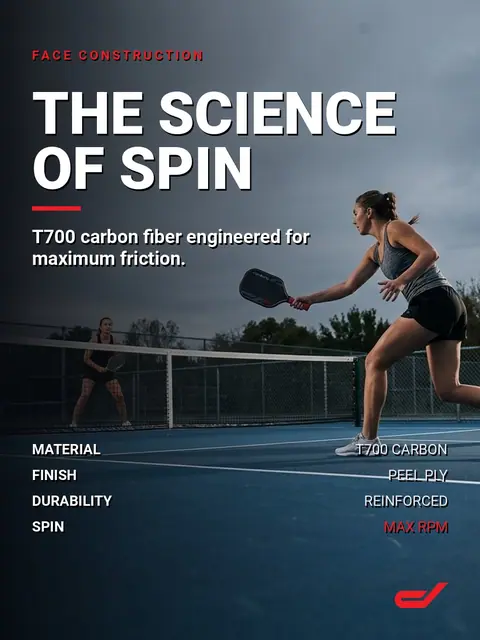
If you look at the best pickleball paddle in India, you will notice a common theme: T700 Raw Carbon Fiber. Unlike traditional paddles that use a sprayed-on grit (which wears down like sandpaper after a few weeks), Raw Carbon Fiber uses the actual weave of the carbon to create friction.
During manufacturing, a 'peel ply' layer is removed from the carbon fiber, leaving behind a naturally textured, microscopic weave. This texture is structural, meaning it is part of the paddle face itself. This is the technology utilized in the DYSSC HexCore Pro, providing a surface that doesn't just look rough but is engineered to hold its friction coefficient over months of heavy play.
Why Material Choice Matters
When comparing Carbon Fiber vs Foam Pickleball Paddle constructions, the face material remains the most critical factor for spin. While foam injection provides stability and a larger sweet spot, the carbon fiber face provides the 'grip.'
T700 Carbon Fiber is preferred over standard carbon because of its higher tensile strength and flexibility. This flexibility increases 'dwell time'—the ball stays on the paddle face longer, giving the surface grit more time to work its magic. Without that millisecond of extra contact, even the roughest surface wouldn't be able to generate maximum RPMs (revolutions per minute).
The Indian Climate: Grit and Longevity
Playing in India presents unique challenges for paddle maintenance. High humidity and airborne dust act as abrasives. On a cheap paddle with sprayed-on grit, the dust actually fills the 'valleys' of the texture, while the heat can cause the bonding agents of the grit to soften and peel.
Raw carbon fiber paddles like the DYSSC HexCore Pro handle these conditions significantly better. Because the texture is woven into the T700 carbon, it cannot 'peel' off. However, players should still be diligent about cleaning their paddles. A simple carbon eraser can remove the plastic residue left behind by the ball, which often clogs the grit and makes the paddle feel smoother than it actually is.
Strategic Advantage: When to Use the Grit
Having a high-grit paddle isn't just about hitting the ball harder. It's about control. In pickleball, spin is used for:
- The Dipping Third Shot Drop: Topspin causes the ball to dive faster after clearing the net, making it harder for your opponent to attack.
- Aggressive Slices: Backspin keeps the ball low after the bounce, forcing your opponent to hit 'up' on the ball, which sets you up for a put-away volley.
- Correcting Errors: A paddle with elite grip can 'rescue' a slightly off-center hit by grabbing the ball and keeping it on its intended path.
Conclusion
Understanding the science of surface grit transforms the way you shop for gear. You are no longer looking for a 'pretty' paddle; you are looking for a precision instrument. By choosing a paddle with T700 Raw Carbon Fiber, you are investing in a surface that provides consistent, predictable friction.
If you are ready to take your game from the baseline to the podium, the DYSSC HexCore Pro offers the technical edge required to master the modern, spin-heavy game.
Frequently asked questions
Does paddle grit wear off over time?
On paddles with sprayed-on textures, yes. However, T700 Raw Carbon Fiber uses a woven texture that is part of the material itself, lasting much longer.
How do I clean a raw carbon fiber paddle?
Use a specialized carbon eraser to rub away the plastic fibers from the ball that get trapped in the weave, restoring the paddle's natural friction.
Does more grit mean more power?
Not necessarily. Grit increases spin and control. Power is generally determined by the paddle's core thickness and weight.
Keep reading
Comments (0)
Be the first to comment.