
Best Pickleball Paddle for Power in 2026: What Actually Matters

Every paddle brand promises "power". Most of that is marketing. Here's what actually determines how hard a paddle hits — and what to look for in 2026.
Where power really comes from
1. The face material
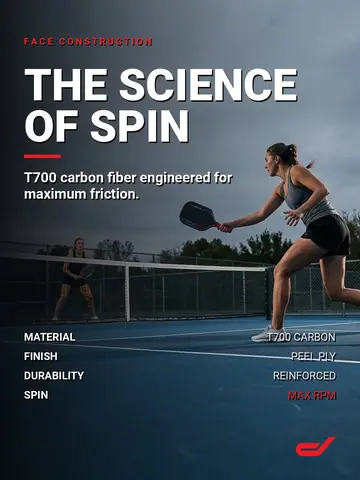
A stiff carbon-fibre face returns more energy to the ball than fibreglass or wood-composite faces. Aerospace-grade weaves like Toray T700 — used on the DYSSC HexCore Pro — are the benchmark: stiff enough for pop, textured enough for spin.
2. The core structure
A polypropylene honeycomb core stores and releases energy efficiently. Density and cell size determine the balance: tighter cells feel crisper and more powerful; larger cells feel softer.
3. Weight and balance
Heavier paddles carry more momentum, but slow your hands. The sweet spot for most players is 7.6–8.0 oz with slightly head-forward balance — enough mass for put-aways without losing the fast hand battles at the net. Our weight guide breaks this down.
4. Aerodynamics (the ignored one)
Power = swing speed², so drag matters more than most specs. Streamlined edges and a tapered throat let you accelerate the paddle faster with the same effort.
The 2026 reality: power WITH control
Thin 13–14 mm "power paddles" are fading. Modern engineering gets the power from the face and aerodynamics, and keeps a 16 mm core for the control and forgiveness that actually win games. Rule-makers have also tightened limits on trampoline-effect faces — another reason balanced designs now dominate. (Always buy USAPA-approved if you might compete.)
Our answer
The DYSSC HexCore Pro was engineered around exactly this philosophy: Toray T700 carbon face for pop, PP honeycomb 16 mm core for forgiveness, aerodynamic edges for swing speed — USA Pickleball approved and built in India. Power when you need it, not error-power on every shot.
Frequently asked questions
What makes a pickleball paddle powerful?
A stiff carbon-fibre face, an efficient honeycomb core, adequate weight (7.6–8.0 oz) and low aerodynamic drag. Swing speed matters more than any single spec — power scales with the square of it.
Are thin paddles more powerful?
Thin 13–14 mm cores feel punchier but sacrifice control and forgiveness. Modern designs get power from the face material and aerodynamics while keeping a 16 mm core for consistency.
Keep reading
Comments (0)
Be the first to comment.