
Inspire Yourself One Shot at a Time: A Practice Mindset That Actually Builds Players
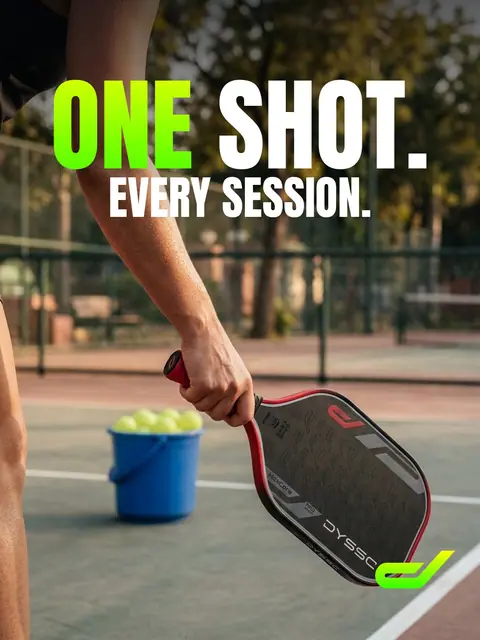
Most players in India came to pickleball from tennis, badminton or squash, and they carry an old habit with them: they judge a session by whether they won. Winning is a terrible feedback signal. You can win a game while shanking every third-shot drop, and you can lose 9-11 while playing the best dinks of your life.
The alternative is simple and slightly boring, which is exactly why it works. Inspire yourself one shot at a time. Pick one shot. Make it measurably better. Repeat. Six weeks later you are a different player, and you never once needed motivation.
Why one shot beats "I want to get better"
"Get better" is not a target your body can act on. Your nervous system learns through specific, repeated, corrected reps. When you walk onto court with a vague ambition, you default to whatever you already do, which is why plateaus feel so sticky.
A single-shot focus does three things:
- It gives you a pass/fail measure for the session, independent of the scoreline
- It reduces cognitive load, so you can actually feel what your wrist and shoulder are doing
- It creates visible progress, which is the only reliable fuel for showing up again on Tuesday
The one-shot session: how it works
Before you leave home, write down one shot. Not two. One. Examples: cross-court backhand dink, third-shot drop from the deuce side, forehand roll volley off a high dink, deep return to the backhand.
Then structure roughly 90 minutes like this:
- 10 minutes warm-up and mobility (do not skip this; see pickleball warm-up and injury prevention)
- 20 minutes cooperative feeding of your chosen shot with a partner, no rally pressure
- 20 minutes the same shot under pressure, with a target and a counted score
- 30 minutes games, where your only rule is to look for that shot when it appears
- 5 minutes write down your number
That number is the whole point. If your target is "cross-court backhand dinks that land inside the kitchen," count out of 50. Twenty-two out of fifty in week one is not a failure. It is a baseline. Week four at thirty-four out of fifty is progress you can see, and seeing it is what makes you come back.
Build a six-week shot ladder
Random practice produces random players. Stack your shots so each one supports the next:
- Week 1: Deep return. Everything downstream is easier when your opponents start from behind the baseline.
- Week 2: Third-shot drop. The single highest-leverage shot in doubles. Aim for depth into the kitchen, not perfection.
- Week 3: Reset off the bounce. Learn to absorb pace from the transition zone instead of panicking.
- Week 4: Cross-court dink. The safest, longest, most patient ball on the court. Our full guide to dinking strategy covers the geometry.
- Week 5: Roll volley. Your first real offensive weapon from the kitchen line.
- Week 6: Speed-up and counter. Now you have something to speed up into, and something to fall back on when it comes back hot.
If you train alone, the wall is a legitimate coach. A stack of solo and partner drills will keep a 30-minute wall session honest.
Practising in Indian conditions
The single-shot approach is especially useful here because our courts are inconsistent. A rooftop court in Bengaluru at 6 am plays nothing like a converted badminton hall in Mumbai at 9 pm, and outdoor courts in Delhi in May are a heat-management problem before they are a technique problem.
Adjust honestly:
- Wind: cut your target margin. On breezy coastal courts, aim your drops a foot deeper and accept a few pop-ups.
- Heat: shorten sessions, not intensity. Forty focused minutes beats two distracted hours.
- Indoor vs outdoor balls: indoor balls fly slower and softer. Log your numbers separately, or you will confuse a ball change for a slump.
- Dusty surfaces: wipe your paddle face between games. A dusty carbon face loses meaningful bite on spin.
The good news is that the growth of pickleball in India means most metros now have three or four courts within a reasonable drive, so finding a consistent weekly slot is far easier than it was even two years ago.
Do not let your gear be a variable
One-shot practice only works if the feedback is honest. If your paddle is flexing unpredictably, or the grit has worn smooth, you are correcting for equipment rather than technique. A raw carbon face with a consistent core, like the DYSSC HexCore Pro, gives you the same response on rep 5 and rep 500, which is what you need when you are measuring yourself in tenths.
If you are still on an entry-level paddle and your dinks feel unpredictable, our breakdown of the best pickleball paddle in India will help you match a paddle to the shot you are trying to build rather than to a marketing claim.
The between-points version
The same idea works inside a match. After a bad point, most players replay it for the next three. Instead, run a three-second ritual: tap the paddle face, breathe out, name the next shot you intend to hit. "Deep return." That is it.
You are not trying to feel confident. You are trying to give your attention a job. Confidence is the by-product of a hundred small, completed jobs.
Start today
Pick one shot. Count fifty reps. Write down the number. Do it again on Thursday.
That is the entire method. It is unglamorous, it works on any court in any city, and it is the only reliable way anyone has ever gotten good at this game.
Frequently asked questions
How long should I practise a single shot before moving on?
Give each shot two to three focused sessions before rotating. Track a countable number, such as successful reps out of fifty, and move on once your success rate stabilises above roughly 60 to 70 percent under mild pressure.
Can I use the one-shot method if I only play social games and never drill?
Yes. Choose one shot before you step on court and look for it during games only. You will hit fewer of them than in a drill session, but the intent alone changes shot selection and builds recognition faster than playing with no focus at all.
Keep reading
Comments (0)
Be the first to comment.