
Attacking the Feet: The Ultimate Target for Winning Pickleball Points
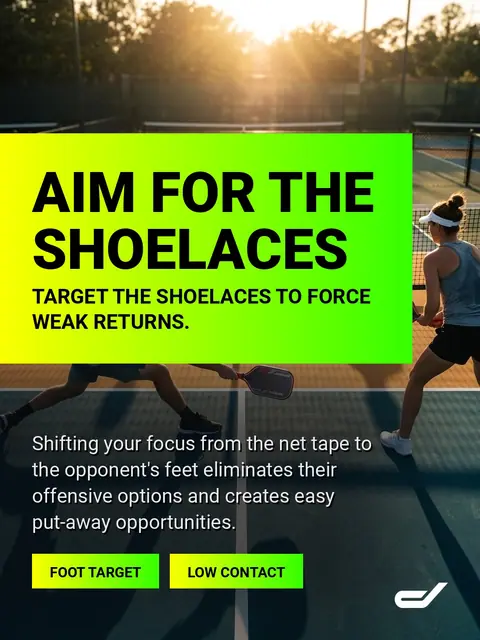
In the early stages of learning pickleball, most players focus on just getting the ball over the net. As they progress, they start aiming for the sidelines or the deep corners, much like in tennis. However, at the 4.0 level and beyond, the most seasoned players stop looking at the lines and start looking at their opponent's shoes.
Attacking the feet is the single most effective way to neutralize aggressive players and force mistakes. Whether you are at the kitchen line or stuck in the transition zone, making your opponent hit from their shoelaces changes the entire geometry of the point. Here is why the feet are the ultimate target and how you can master this strategy.
The Physics of the Low Ball
Pickleball is a game of margins. Because the net is 34 inches high at the center and the ball doesn't have the same aerodynamic properties as a tennis ball, any ball hit from below net height must be hit upward to clear the tape.
When you target an opponent’s feet, you force them into a 'low-to-high' swing path. This does two things: it takes away their ability to hit the ball hard (as a hard upward shot will fly out of bounds) and it often results in a 'pop-up'—a weak, high return that you can easily smash. By consistently hitting at the feet, you are essentially daring your opponent to try an offensive shot from a defensive position, which is where most unforced errors occur.
Three Scenarios Where Targeting the Feet Wins Points
1. The Transition Zone Reset
If you find yourself caught in 'No Man's Land' while your opponents are already established at the kitchen, do not try to hit a winner. Instead, aim your drop shot or reset specifically at their feet. If they have to reach down to volley the ball, they cannot punish you with a downward overhead. This gives you the precious second you need to finish your pickleball footwork and reach the safety of the non-volley zone.
2. Neutralizing the Banger
When you are playing against someone who hits every ball with maximum velocity, aiming for their chest or shoulders often plays into their hands, as they can simply block the ball back. However, a 'banger' usually struggles with touch. By dipping the ball at their feet, you force them to take pace off the ball. If you want to know how to beat a banger, the answer is almost always to keep the ball below their knees.
3. The 'Chicken Wing' and the Hip Aim
While the feet are the primary target, the 'hip' of the paddle-side arm is a secondary 'foot-adjacent' target. When a ball is aimed at the dominant hip or the feet on that side, the opponent often gets jammed, resulting in the 'chicken wing'—a cramped, ineffective return. This is particularly effective during fast-paced hand battles at the net.
Precision Over Power: The Right Gear
To successfully target the feet, you need a paddle that offers extreme 'reset' capability and vibration dampening. A paddle that is too 'poppy' will often cause your dinks to sit too high, allowing the opponent to attack you instead. This is where the DYSSC HexCore Pro excels. Its Toray T700 Raw Carbon Fiber face provides the friction needed to dip the ball late in its flight path, ensuring it lands at the opponent's shoelaces rather than in their strike zone.
Choosing the best pickleball paddle in India often comes down to finding that balance between a large sweet spot and the control needed for surgical placement. When you can trust your paddle to absorb the pace of an incoming drive and drop it softly at the opponent's feet, you dictate the tempo of the match.
How to Practice Targeting the Feet
Mastering this doesn't require more power; it requires better 'feel.' In the rapidly growing world of pickleball in India, many players are moving from badminton where the wrist flick is dominant. In pickleball, you want a more stable, shoulder-driven motion for these targeting shots.
The 'Shoes' Drill: Have a partner stand at the kitchen line while you stand in the transition zone. Have them feed you moderately paced balls. Your goal is not to hit it past them, but to hit every single ball so it bounces within 6 inches of their toes. If they can catch the ball at waist height, you lose the point. If they have to reach down, you win.
Conclusion
Stop looking for the highlight-reel winners down the line. The most efficient way to win a pickleball game is to make your opponent uncomfortable, and nothing is more uncomfortable than playing from the floor. By shifting your focus to the feet, you force your opponents into a defensive mindset, neutralize their power, and set yourself up for easy finishes. Equip yourself with a control-oriented paddle like the DYSSC HexCore Pro and start aiming low—your win rate will thank you.
Frequently asked questions
Why is hitting the ball at the feet better than hitting it hard?
Hitting hard often allows opponents to use your own pace against you. Hitting at the feet forces them to hit upward, which usually results in a weak pop-up that you can then smash.
What is the best way to aim for the feet during a fast rally?
Focus on keeping your paddle face slightly closed and use a short, pushing motion rather than a full swing. Aim for the opponent's dominant hip or their toes.
Does paddle choice affect my ability to hit low shots?
Yes. A control-oriented paddle with a carbon fiber face, like the DYSSC HexCore Pro, allows for more spin and better shock absorption, making it easier to place the ball accurately at the feet.
Keep reading
Comments (0)
Be the first to comment.