
How to Beat a Banger: Neutralizing Power Players in Pickleball
Walk onto any court in Mumbai, Bengaluru or Gurugram on a weekend morning and you will meet one: the banger. Ex-badminton smasher, ex-tennis forehand, or just someone who discovered that hitting hard feels great. Every ball comes back flat and fast. No drops, no dinks, just pace.
Bangers win a lot of games at 3.0 and 3.5 level. They lose almost all of them above 4.0. The reason is simple, and once you understand it, you can borrow the 4.0 answer today.
Why Bangers Win (And Why It Stops Working)
A banger beats you with time pressure, not placement. They are betting that you will do one of three things:
- Panic and pop the ball up, giving them an easy put-away
- Swing back just as hard and miss, because you are matching pace on a ball that already has pace
- Back off the kitchen line so you have more reaction time, which surrenders the entire court
Notice that none of those are the banger beating you. All three are you beating yourself. Their drive is only a weapon if you supply the second half of the mistake.
Rule One: Do Not Answer Power With Power
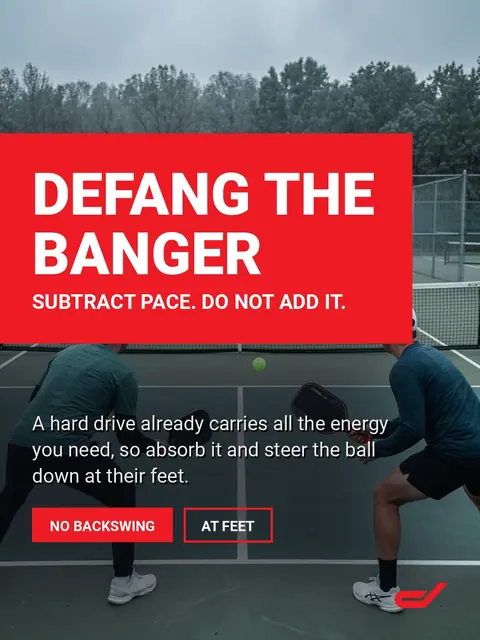
When a ball arrives at 60 kmph, all the energy you need is already in the ball. Your job is to subtract, not add.
The block volley is the single most valuable shot against a banger:
- No backswing. Paddle stays in front of your chest. If your paddle goes behind your shoulder, you are late.
- Loose grip. Grip pressure around 3 out of 10. A tight grip turns your paddle into a trampoline and the ball flies long.
- Paddle face slightly open, pointed at the opponent's feet, not at their chest.
- Absorb with the shoulder, letting the hand give a couple of centimetres backward on contact.
Done correctly, the drive comes back as a soft ball that dies at their toes. That is the moment the rally flips: the banger is now the one who has to hit up, and bangers hate hitting up.
Rule Two: Hold the Line
The instinct against pace is to retreat. Do not. Standing two metres behind the kitchen line means the ball has more time to drop below your knees, which forces you to hit up. Counter-intuitively, standing at the non-volley line gives you the ball earlier, higher and easier to block.
If you have been driven off the line, get back with controlled resets rather than one big swing. Our guide to mastering the reset shot breaks down the exact contact point and paddle angle for that recovery.
Rule Three: Attack Their Feet and Their Backhand Hip
Bangers generate power with a big rotation and a long swing. Two targets remove that:
- The feet. A ball at the shoelaces cannot be driven. There is no room to swing.
- The backhand hip. Jamming a right-hander's left hip removes both the forehand and the clean backhand. They have to make a decision, and deciding takes 200 milliseconds they do not have.
Add a third, slightly cruel option: hit soft to the middle. Bangers usually play with a partner who is also unsure who takes the middle ball, and a floating middle dink causes more errors than any hard shot you own.
Rule Four: Start the Point Right
Most banger points are won or lost before the third shot. A short, floaty return gives them a mid-court ball at chest height, which is their favourite thing in the world. A deep return pins them behind the baseline and takes 30 percent off their drive. If your return is landing mid-court, revisit the return of serve before you work on anything else in this article.
Rule Five: Let Them Cook
Track the score honestly for one game. Bangers typically produce roughly a third of their own points as unforced errors when the ball keeps coming back. Your job is not to win the point, it is to extend the point. Every extra ball you return raises their error probability. Three blocks in a row and most bangers start reaching for a bigger swing, and the bigger swing goes into the net.
Equipment Actually Matters Here
Blocking pace is a dwell time problem. A stiff, thin, ultra-poppy paddle sends fast balls back fast, straight into the net or off the baseline. A thicker core with a raw carbon face holds the ball a fraction longer and lets you steer it down at their feet.
This is why so many players who face heavy hitters drift towards 16mm control builds. The DYSSC HexCore Pro was designed around exactly that trade: a soft, forgiving pocket for blocks and resets without giving up the plow-through you need on your own drives. If you are still comparing options, our breakdown of the best pickleball paddle in India covers how core thickness changes what a paddle does under pressure.
A Two-Week Practice Plan
- Days 1 to 4: Wall blocks. Stand three metres from a wall, drive once, then block every rebound with no backswing. Target 30 in a row.
- Days 5 to 9: Partner feeds hard drives from the baseline while you block from the kitchen line. Aim at a towel placed at their feet.
- Days 10 to 14: Live games where you are not allowed to hit any ball harder than the one you received. Frustrating, and enormously effective.
The Mindset Shift
Against a banger, you are not in a fight. You are in a filter. Keep the ball low, keep it in, keep your paddle in front, and let their swing size do the rest. The fastest-growing courts in pickleball in India are full of players discovering that patience beats power roughly nine times out of ten once the level rises.
Stop trying to out-hit them. Start trying to out-last them.
Frequently asked questions
What is a banger in pickleball?
A banger is a player who drives almost every ball hard and flat instead of using drops, dinks or resets. They rely on pace and time pressure rather than placement, and they are most effective at beginner and intermediate levels where opponents pop the ball up under pressure.
Should I use a heavier paddle against hard hitters?
A slightly heavier, thicker paddle helps because extra mass resists twisting when a fast ball hits off-centre, and a thicker core softens the rebound so blocks land short. Most control-oriented players facing bangers use a 16mm core in the 210 to 225 gram range.
Keep reading
Comments (0)
Be the first to comment.