
The Pickleball Fourth Shot: How to Handle a Perfect Third Shot Drop
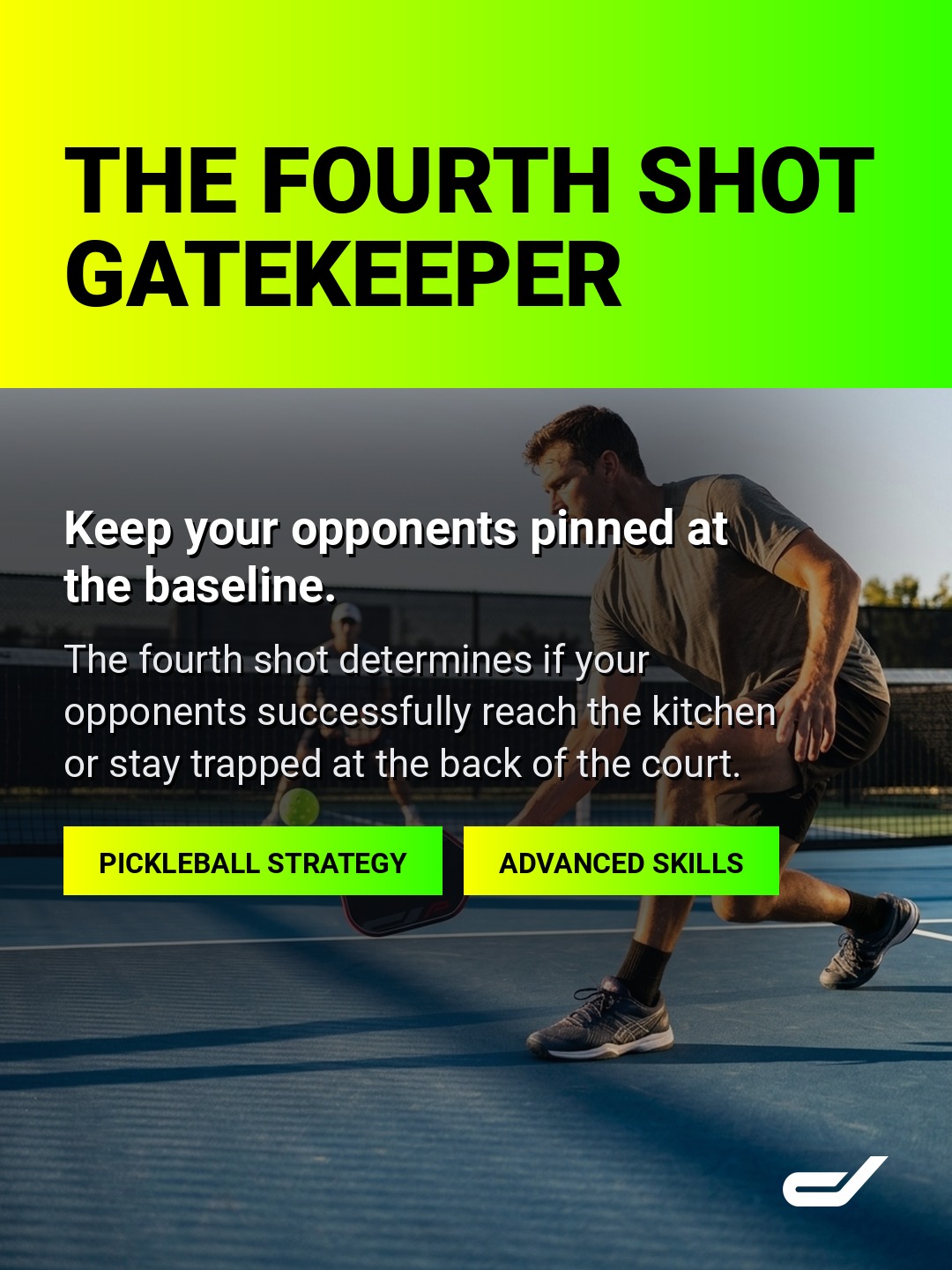
In the world of pickleball, the third-shot-drop-pickleball gets all the glory. It is the great equalizer, the shot that allows the serving team to neutralize the advantage of the receiving team and move safely to the kitchen. But for the players already standing at the Non-Volley Zone (NVZ), the story doesn't end there. Their response—the fourth shot—is what determines who actually wins the point.
The fourth shot is the receiving team's chance to say 'not so fast.' If you play a lazy or defensive fourth shot, you invite your opponents to the net, turning a winning position into a 50/50 scramble. However, if you master the fourth shot, you can trap your opponents at the baseline and force errors before they ever reach the kitchen line.
What Exactly is the Fourth Shot?
In pickleball sequencing, the fourth shot is hit by the team that received the serve. After the return of serve is hit deep, the serving team usually attempts a drive or a drop (the third shot). The fourth shot is your team's response to that third shot.
Because the receiving team is already established at the kitchen line, they have a massive geographic advantage. The goal of the fourth shot is to maintain that advantage. You want to keep the ball deep, keep it low, or attack it with enough pace that the opponents cannot move forward.
Strategy 1: The Deep Volley (Keep Them Back)
The most common mistake Indian players make on the fourth shot is 'catching' the ball and dinking it back softly. While a soft response feels safe, it is exactly what the serving team wants. It gives them a 'free pass' to run to the kitchen.
Instead, your primary goal should be to volley the ball deep. If the third shot drop is a little high, don't let it bounce. Take it out of the air and push it back toward the opponent's feet near the baseline. By keeping the ball deep, you force them to hit a 'fifth shot' from the back of the court, which is much harder to execute than a kitchen-side dink.
Strategy 2: Attacking the 'Dead' Drop
If your opponent hits a perfect drop that is landing in the kitchen, you may have to let it bounce. However, if the ball has any height at all as it crosses the net, you have an opportunity to be aggressive. This is where high-performance equipment makes a difference. When using the DYSSC HexCore Pro, the raw T700 carbon fiber surface allows you to roll the ball with extreme topspin, even when it is low.
Instead of just pushing the ball back, use a flick or a roll volley. By brushing up on the back of the ball, you can generate pace and dip that targets the feet of the transitioning opponent. This 'speed up' on the fourth shot is one of the most effective ways to end a point early.
Strategy 3: The Directional Fourth
Placement is often more important than power. When you are looking for the best pickleball paddle in India, you want something that offers a massive sweet spot for directional control. On the fourth shot, try these three placement targets:
- The Middle: Hitting the fourth shot down the middle causes confusion between partners and limits their angle for the fifth shot.
- The 'Weak' Partner: If one opponent is slower to move forward, target their feet. They will be caught in 'no man's land' (the transition zone).
- The Backhand: Most players have a harder time hitting a reset shot from their backhand side while moving.
When to Reset the Fourth Shot
Sometimes, your opponent hits an incredible third shot drop—one that is so low and short that you have no choice but to dink it back. In this scenario, you must prioritize a safe, unattackable dink. This is essentially a master-pickleball-reset-shot played from the kitchen line. Focus on keeping the ball low over the net to ensure your opponents cannot attack you as they move in.
The Mental Game: Patience vs. Aggression
As the community for pickleball in India continues to grow, the level of play is shifting from simple 'banging' to a more tactical game. The fourth shot requires a mental shift. You are the 'gatekeeper' of the kitchen. Your job is to make life as difficult as possible for the team trying to get in.
Don't feel like you have to end the point on the fourth shot every time. Often, the best fourth shot is simply a deep, boring volley that keeps the pressure on. Consistency kills in pickleball.
Drill: The 4th Shot Pressure Drill
To improve this skill, try this drill with a partner:
- Partner A stays at the baseline and hits 3rd shot drops.
- Partner B (you) stays at the kitchen line.
- Your goal is to hit every 4th shot past the transition zone (deep).
- If Partner A manages to reach the kitchen line, they win a point. If you keep them back for three consecutive shots, you win the point.
Mastering this sequence will change your win rate overnight. By turning your fourth shot into a weapon, you stop being a passive observer and start dictating the pace of the match.
Frequently asked questions
What is the primary goal of the 4th shot?
The primary goal is to keep the serving team back at the baseline or in the transition zone, preventing them from reaching the kitchen line.
Should I always volley the 4th shot?
Yes, whenever possible. Taking the ball out of the air takes time away from your opponents and keeps them from moving forward.
What if the 3rd shot drop is too low to volley deep?
If the ball is too low, hit a controlled dink back into the kitchen, ensuring it stays low so your opponents cannot attack as they move in.
Comments (0)
Be the first to comment.