
Mastering the Third Shot Drop: The Essential Tool for Winning Pickleball
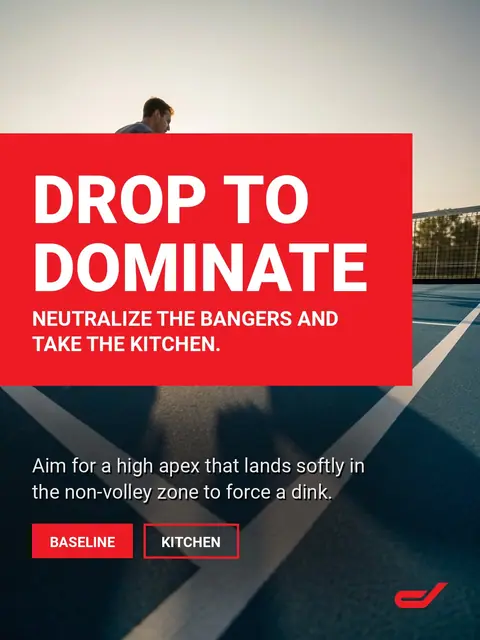
If you ask any professional player which single shot defines the difference between a beginner and an advanced player, they won't say the power serve or the overhead smash. They will say the Third Shot Drop.
The third shot drop is often called the 'Great Equalizer.' In a game dominated by fast-paced 'bangers' and aggressive drives, the drop is the strategic reset that forces your opponents to play your game. As the level of pickleball in India continues to rise, mastering this soft touch is no longer optional—it is a requirement for anyone looking to compete at a 3.5+ DUPR level.
What is the Third Shot Drop?
The third shot drop is a soft, arcing shot hit from the baseline (or near it) that lands shallow in the opponent’s non-volley zone (the kitchen). The goal is not to win the point outright, but to force the opponents to hit the ball while it is on a downward trajectory, making it impossible for them to attack or smash it.
By landing the ball in the kitchen, you 'earn' your way to the net. Because the ball is un-attackable, you and your partner have enough time to move from the baseline to the kitchen line, neutralizing the advantage of the serving team.
The Physics of the Perfect Arc
A successful third shot drop relies on gravity and depth control. Unlike a drive, which uses linear velocity to beat an opponent, the drop uses a parabolic arc. The apex (highest point) of your shot should occur on your side of the net or directly over it. If the apex is too far forward, the ball will likely land deep in the transition zone, inviting a punishing volley.
When selecting the best pickleball paddle in India, players often look for 'plush' or 'control-oriented' faces. A paddle with a high twist weight, like the DYSSC HexCore Pro, provides the stability needed to ensure that even off-center drops maintain enough energy to clear the net while remaining soft enough to stay in the kitchen.
Key Technical Cues for the Drop
1. Minimal Backswing
One of the biggest mistakes players make is taking a massive 'tennis-style' backswing. A drop is a lift, not a strike. Keep your paddle out in front of your body. Think of the motion as a 'push' or a 'lift' originating from the shoulder, not the wrist. Reducing moving parts in your swing reduces the margin for error.
2. Open Paddle Face
To create the necessary arc, your paddle face must be slightly open (tilted toward the sky). This allows you to get under the ball and lift it over the net. If your paddle face is too vertical, you will likely hit the net or produce a flat trajectory that is easy for opponents to volley.
3. Grip Pressure: The 3/10 Rule
Grip pressure is the secret sauce of the soft game. On a scale of 1 to 10, your grip for a third shot drop should be around a 3. If you squeeze the handle too tight, the paddle becomes a 'trampoline,' and the ball will pop up too high. A loose grip allows the paddle's core to absorb the ball’s energy, resulting in a softer, more controlled response. This is why proper pickleball footwork is essential; if you are balanced, you don't need to 'clutch' the paddle for stability.
Strategic Placement: Where to Aim
While any drop in the kitchen is generally 'good,' aiming for specific targets can make it 'great.'
- The Middle: Dropping the ball into the 'center T' of the kitchen is the safest play. It limits the angles your opponents can use for a return and often causes confusion between partners about who should take the ball.
- The Opponent's Backhand: Most players have a weaker backhand dink. Aiming your drop toward their backhand foot often leads to a weaker fourth shot, giving you an even better chance to finish the point.
- The 'Dink' Distance: Try to land the ball 1–2 feet past the net. This forces the opponent to reach forward, making it difficult for them to generate any pace on their response.
Handling the 'Short' Drop
Sometimes, your drop might land a bit too high. This is where your defensive skills come in. If you see your drop is 'attackable,' do not rush to the kitchen. Instead, stay back or stop in the transition zone and prepare to hit a master-pickleball-reset-shot. Only move forward when you are certain your shot has forced the opponent to hit upward.
Why Gear Matters for the Soft Game
The third shot drop is a 'feel' shot. If your paddle is too stiff or lacks vibration dampening, you will struggle with consistency. The DYSSC HexCore Pro utilizes a specialized Toray T700 Raw Carbon Fiber surface. This 'grit' allows you to put a slight amount of topspin on your drop, which helps the ball dip faster after it clears the net—a massive advantage when trying to keep the ball at your opponent's feet.
Drills to Improve Your Drop
- 7-11 Drill: One player stays at the kitchen (the 'feeder'), and the other stays at the baseline. The baseline player must hit 11 successful drops into the kitchen to win, while the kitchen player tries to keep them back using volleys.
- Drop and Move: Practice hitting a drop and immediately taking two steps forward toward the kitchen. This builds the muscle memory of following your successful shots.
Mastering the third shot drop takes patience and thousands of repetitions, but it is the single most rewarding investment you can make in your pickleball journey. Once you can drop at will, you stop being a victim of your opponent’s power and start being the architect of the point.
Frequently asked questions
Should I always hit a third shot drop?
Not necessarily. If the return of serve is short, a third shot drive may be more effective. However, the drop is the safest way to get to the kitchen against a deep return.
How high should the arc be on a drop shot?
The arc should be high enough to safely clear the net but low enough that the apex is on your side of the court, ensuring the ball is descending as it reaches the opponent.
What is the best grip pressure for a third shot drop?
Use a light grip pressure, roughly a 3 out of 10. This prevents the ball from 'popping' off the paddle and helps you maintain better touch.
Keep reading
Comments (0)
Be the first to comment.