
How to Go From 3.0 to 4.0 in Pickleball: The Skills That Actually Move You Up
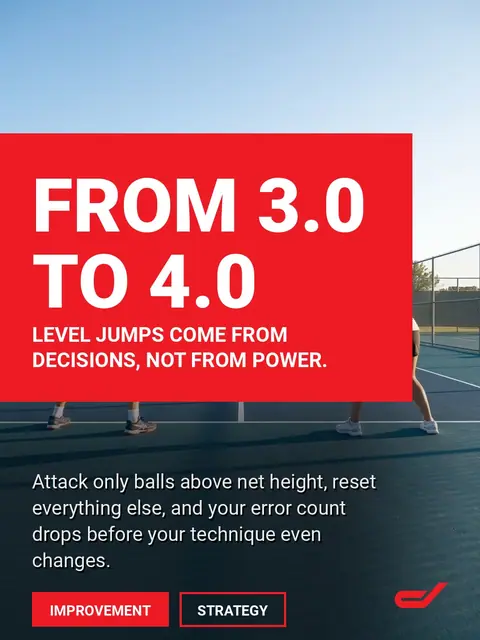
Most players plateau at 3.0 for a year or more. Not because they can't hit hard enough, but because they keep hitting the wrong ball at the wrong time from the wrong place. A 4.0 isn't a 3.0 with a faster arm. A 4.0 is a 3.0 who stopped donating points.
Here is what actually changes between those two levels, and how to train each piece.
1. You stop attacking balls that aren't attackable
The single biggest gap between 3.0 and 4.0 is shot selection. A 3.0 sees a dink at knee height and swings. A 4.0 sees the same ball, recognises it's below net height, and dinks it back cross-court to a worse spot.
The rule 4.0s live by: only attack balls above the top of the net. Everything below that gets lifted, reset, or redirected.
Test yourself in your next three games. Count how many unforced errors came from balls you attacked below net height. For most 3.0s the number is between six and ten a game. Cut that to two and you have already gained a rating band.
2. Your third shot becomes a decision, not a habit
3.0s pick one third shot and repeat it forever. Either they drop everything (and float half of them) or they drive everything (and pop up half of them).
4.0s read the return before they choose:
- Deep return, at your feet — drop it, or reset and take your time getting in
- Short return, chest height — drive it, then crash and volley the block
- Return with pace but sitting up — drive at the returner's right hip if they're right-handed
The drive is not a better shot than the drop. It's a different tool. Owning both, and knowing which one the incoming ball allows, is a 4.0 skill.
3. You can reset from anywhere on the court
At 3.0, a hard ball at your feet in the transition zone is a lost point. At 4.0, it's a neutral ball.
This is the highest-return skill you can drill, because it converts losing rallies into ongoing rallies. Soft hands, no backswing, paddle out front, and the ball dies in the kitchen. Work through the reset shot and the transition zone until blocking a drive at your ankles feels boring rather than terrifying.
A useful drill: stand two steps behind the kitchen line while a partner drives at you from the baseline. Ten balls. Score a point every time your reset lands inside the kitchen. Most 3.0s start at 2/10. Get to 7/10 and your game changes.
4. You move as a pair, not as two individuals
Watch any 4.0 doubles team and you'll see them connected by an invisible rope roughly four metres long. Partner pulled wide to the sideline? The other player shifts to cover middle, not stays home guarding a line nobody is hitting.
Three movement habits to install:
- Shift together laterally with the ball, not against it
- Both up or both back — split positioning is how 3.0 teams get lobbed and dropped to death
- Recover diagonally, not straight back, after being pulled off court
5. Your serve and return get deep, every single time
This is the least glamorous item on the list and the most reliable. A return that lands within a metre of the baseline buys you three extra steps of approach time. A short return gives your opponents a free attack.
4.0s hit 90 percent of returns deep with margin over the net. They aren't hitting harder. They're hitting with more arc and more topspin, which is safer, not riskier.
Does your paddle matter here?
Somewhat. At 3.0, technique dominates. But once you're resetting and dropping regularly, a paddle with a raw carbon face and a thicker core gives you measurably more control on soft shots and a bigger sweet spot on off-centre blocks.
Players making this jump usually move from a thin, poppy entry paddle to something like the DYSSC HexCore Pro, where the 16mm core absorbs pace instead of firing it back. If you're comparing options, our breakdown of the best pickleball paddle in India covers what actually changes at this level. Do not, however, expect equipment to fix shot selection. Nothing fixes shot selection except discipline.
A six-week plan that actually works
- Weeks 1-2: 20 minutes of dinking per session with a rule — no attacking any ball below net height. Play out points.
- Weeks 3-4: Third-shot decision drill. Partner returns randomly short or deep, you choose drive or drop accordingly. 50 reps.
- Weeks 5-6: Reset drill under pace, plus doubles games where you and your partner call out "switch", "mine", and "bounce it" every rally.
Play at least two competitive sessions a week alongside this. Drilling without live play builds strokes without judgement.
Track it honestly
Rating jumps are slow and self-assessment is unreliable. Log matches so your progress shows up in data rather than in feeling. If you're unclear on how the numbers move, read what your DUPR number really means before you obsess over decimals.
The 3.0-to-4.0 climb usually takes six to twelve months of deliberate work. With the volume of organised play and league nights now available across pickleball in India, the reps are easier to find than they've ever been. What's scarce is the patience to keep hitting the boring ball when the flashy one is right there.
Frequently asked questions
How long does it take to go from 3.0 to 4.0 in pickleball?
For most players playing three to four times a week with structured drilling, six to twelve months is realistic. Players coming from tennis or badminton often move faster because their footwork and racquet skills transfer, but they still need time to learn soft-game restraint.
Should I buy a new paddle to reach 4.0?
Only after your technique is stable. A control-oriented raw carbon paddle with a 16mm core helps once you are actually resetting and dropping regularly, because it absorbs pace instead of popping the ball up. It will not fix poor shot selection.
Is drilling better than playing games for improvement?
You need both. Drilling builds the stroke, live play builds the judgement of when to use it. A good ratio at this level is roughly one drilling session for every two competitive sessions per week.
Keep reading


Comments (0)
Be the first to comment.