
Mastering the Reset Shot: How to Survive the Pickleball Transition Zone
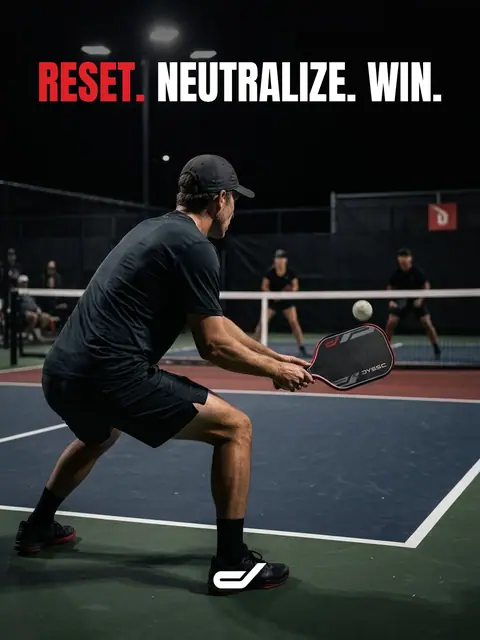
In the world of competitive pickleball, the space between the baseline and the non-volley zone (the kitchen) is often referred to as 'No Man’s Land.' If you stand there without a plan, you are a sitting duck for overhead smashes and aggressive drives. However, advanced players know that this area—the Transition Zone—is actually where the most sophisticated defensive work happens.
The key to surviving this zone and turning a defensive position into an offensive one is the Reset Shot. A reset is a soft, controlled shot that takes the pace off an opponent's hard drive or volley, dropping the ball gently into their kitchen. This forces them to hit upward, neutralizing their advantage and allowing you to move forward to the net.
Why the Reset Shot is Critical for Your Game
Most intermediate players focus on hitting the ball harder when they are under pressure. This is a mistake. When you are caught in the transition zone, your opponent has the positional advantage. If you hit a hard ball back, it likely comes back even faster, giving you less time to react.
By mastering the reset, you effectively 'hit the brakes' on the rally. It is the ultimate tool for pace management. If you can successfully drop a 50mph drive into the kitchen from mid-court, you have successfully neutralized the point. This skill is particularly important in India's rapidly evolving competitive scene, where players are increasingly leaning into a high-power game.
The Mechanics of a Perfect Reset
A successful reset shot requires a combination of body positioning, paddle control, and mental discipline. Unlike a drive, where you generate force, a reset is about absorbing energy.
1. Soft Hands and Grip Pressure
The most common reason players fail at the reset is a 'death grip' on the paddle. If you hold your paddle too tightly, the ball will bounce off the face like it hit a brick wall, flying long or high. On a scale of 1 to 10, your grip pressure for a reset should be around a 3 or 4. Think of your paddle as a sponge, not a shield. You want the ball to die on the paddle face.
2. Stability Through the Core
While your hands must be soft, your base must be solid. You should be in a wide, athletic stance with your knees bent. Staying low allows you to see the ball's trajectory more clearly and ensures you aren't reaching or leaning, which leads to unforced errors. Using a stable, well-balanced paddle like the DYSSC HexCore Pro provides the necessary surface area and vibration dampening to make these delicate touches more consistent.
3. Short Backswing, No Follow-Through
A reset is not a swing; it is a block with a slight push. Keep your paddle out in front of your body where you can see it. Your backswing should be almost non-existent. You are simply meeting the ball and guiding it toward the kitchen. A large follow-through will almost always result in the ball landing too deep in the opponent’s court.
Navigating the Transition Zone
The goal of the transition zone is to get out of it as quickly as possible—but only when it is safe to do so. This is often linked to the third-shot drop. If your drop or reset is high, you must stay back or split-step. If your reset is successful and lands low in the kitchen, that is your signal to move forward.
The Split-Step is Non-Negotiable: Never be caught moving while your opponent is striking the ball. As soon as you see your opponent about to hit, stop and perform a small hop into a balanced, wide stance. This allows you to react in any direction. Even if you are only halfway to the kitchen, stopping and resetting is better than running through a shot and popping it up.
Choosing the Right Equipment for Defensive Play
While skill is paramount, the physics of your paddle plays a massive role in your ability to reset. High-stiffness paddles often lack the 'dwell time' needed to feel the ball. Carbon fiber faces are generally preferred for resets because they offer a more predictable response. Understanding how paddle weight and thickness affect your control can help you choose gear that complements a defensive, reset-heavy style of play.
The DYSSC HexCore Pro features a Toray T700 Carbon Fiber face specifically designed to provide that 'plush' feel required for elite resets. The honeycomb core absorbs the shock of a hard drive, making it significantly easier to kill the momentum of the ball and drop it short.
Drills to Improve Your Resets
1. The Wall Reset Drill: Stand about 7-8 feet away from a wall. Hit the ball hard against the wall and try to 'catch' the rebound with your paddle, letting it drop softly to the floor right at the base of the wall. Focus on keeping your hands relaxed.
2. Transition Scramble: Have a partner stand at the kitchen line while you start at the baseline. Have them feed you aggressive drives. Your goal is to hit a reset and move one step forward with every successful soft shot. If you pop one up, you must retreat to the baseline and start over.
Summary
Mastering the reset shot is what separates 'bangers' from true pickleball players. By learning to embrace the transition zone rather than fearing it, you take away your opponent's greatest weapon: pace. Focus on soft hands, a stable base, and the right equipment, and you will find yourself winning more points by simply outlasting your competition.
Frequently asked questions
What is the difference between a dink and a reset?
A dink is a soft shot hit while you are already standing at the kitchen line. A reset is a soft shot hit from the transition zone or baseline to neutralize an opponent's pace and allow you to move forward.
How do I stop popping up my reset shots?
Pop-ups usually happen because of too much grip pressure or too much paddle movement. Relax your hands and focus on a very short, compact motion that absorbs the ball's energy rather than adding to it.
Is a heavier paddle better for resets?
Generally, yes. A slightly heavier paddle (8.0 - 8.3 oz) has more stability and is less likely to get twisted in your hand when hit by a fast ball, which helps in making a controlled reset.
Keep reading
Comments (0)
Be the first to comment.