
Mastering the Transition Zone: How to Navigate 'No Man's Land'
Mastering the Transition Zone: How to Navigate 'No Man's Land'
In the world of pickleball, the most dangerous place to stand is often referred to as 'No Man’s Land.' Officially known as the transition zone, this is the area between the baseline and the Non-Volley Zone (the kitchen) line. For many players in India, especially those transitioning from tennis or badminton, this middle ground feels like a death trap where opponents aim for your feet and every shot seems unreturnable.
However, to become a high-level player, you cannot fear the transition zone. You must master it. The transition zone is not a place where you want to live, but it is a place you must navigate with poise to reach the safety of the kitchen. If you can’t handle the transition, you’ll never be able to execute a proper dinking strategy because you’ll be pinned at the back of the court.
What is the Transition Zone?
The transition zone covers the 5 to 10 feet of space between the back baseline and the kitchen. It is called 'No Man’s Land' because you are vulnerable here—you are too far forward to let the ball bounce comfortably and too far back to volley it aggressively. Your opponents will almost always target your feet in this area, forcing you to hit difficult, low-to-high defensive shots.
The goal is simple: move through this zone as quickly and safely as possible. But 'quickly' doesn't mean 'recklessly.' It requires a combination of rhythmic footwork, soft hands, and the right equipment.
The Foundation: The Split Step
The biggest mistake players make in the transition zone is running while their opponent is hitting the ball. If you are in motion when the ball is struck, your weight is poorly distributed, making it nearly impossible to react to a shot aimed at your shoes.
To solve this, you must use the split step. As soon as you see your opponent's paddle make contact with the ball, you should perform a small, balanced hop, landing with your feet shoulder-width apart and your weight on the balls of your feet. This 'neutralizes' your momentum and allows you to move in any direction. You might have to split-step two or even three times as you work your way forward from the baseline.
Paddle Positioning: Building the Wall
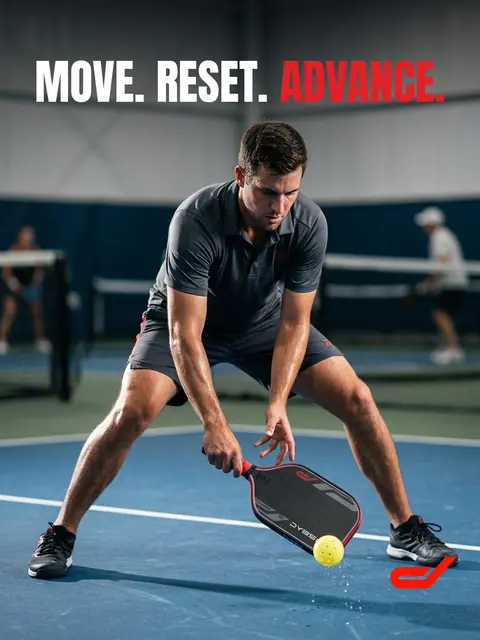
When you are in the transition zone, your paddle should be out in front of your body, held slightly lower than usual. Think of your paddle as a shield protecting your feet. Many players keep their paddle high (at chest level), which is great at the kitchen but disastrous in transition. By keeping the paddle low and out front, you reduce the distance the ball has to travel to meet your paddle, giving you more control over the deflection.
This is where the quality of your gear becomes evident. Using a paddle like the DYSSC HexCore Pro provides a distinct advantage here. Its Toray T700 carbon fiber face and polymer honeycomb core are designed to absorb the energy of hard-hitting 'bangers.' When you are caught in the transition zone, you don't want the ball to trampoline off your paddle; you want a stable, dampened surface that allows you to 'reset' the ball into the opponent's kitchen.
The Art of the Reset Volley
A 'reset' is a shot that takes the pace off a fast-moving ball and drops it softly into the opponent's kitchen. It is the single most important skill for surviving the transition zone. Instead of trying to hit a winner from No Man’s Land, your only objective should be to neutralize the point.
To hit a successful reset:
- Loosen your grip: On a scale of 1 to 10, your grip pressure should be around a 3 or 4.
- Shorten your backswing: There should be almost no backswing at all. Think of it as a 'block' rather than a 'swing.'
- Follow through to the kitchen: Use a gentle lifting motion to ensure the ball clears the net but doesn't sit up too high for the opponent to smash.
Successfully hitting a reset buys you the time you need to take two or three more steps forward. Mastering this follow-up to the third-shot drop is what separates intermediate players from advanced ones.
Common Transition Zone Mistakes
- Backing Up: When a ball is hit at your feet in the transition zone, the instinct is to jump backward. This actually makes the shot harder and keeps you in the danger zone longer. Stay grounded or move forward.
- Over-hitting: Trying to drive the ball from the middle of the court is high-risk and low-reward. Your opponents are likely already at the kitchen, and a hard shot gives them a fast ball to volley right back at you.
- Looking at the Net: Don't watch the net; watch the opponent's paddle. This gives you the split second of extra reaction time needed to stop and set your feet.
Moving as a Team
In doubles, the transition zone is a team effort. You and your partner should move like they are connected by a 10-foot rope. If your partner is stuck in transition, you should stay back or hover slightly behind the kitchen line to support them. If you rush to the kitchen while your partner is struggling in No Man’s Land, you leave a massive diagonal gap in the middle of the court that smart opponents will exploit.
Conclusion
Mastering the transition zone is about patience and discipline. It is about accepting that you are temporarily at a disadvantage and working methodically to neutralize that disadvantage. By implementing the split step, keeping your paddle low, and focusing on soft resets with a high-control paddle like the DYSSC HexCore Pro, you will find that 'No Man's Land' is no longer a place to fear, but a place where you win points by outlasting your opponents' aggression.
Next time you're on the court, practice 'stop-and-hit' drills. Have a partner fire balls at your feet while you start at the baseline and slowly work your way to the kitchen, one reset at a time. Your win rate will thank you.
Frequently asked questions
Why is the transition zone called No Man's Land?
It's called No Man's Land because players are highly vulnerable there. You are far enough back that opponents can hit the ball at your feet, but too far from the net to hit aggressive, downward volleys.
Should I ever stay in the transition zone on purpose?
Generally, no. Your goal should always be to reach the kitchen line. However, elite players sometimes pause there to wait for a better ball to transition on, rather than rushing into a smash.
How can I stop 'popping up' the ball when I'm in the middle of the court?
Popping the ball up usually happens because of a grip that is too tight or a swing that is too large. Loosen your grip to a '3 out of 10' and focus on a soft block rather than a full stroke.
Keep reading
Comments (0)
Be the first to comment.