
Stacking in Pickleball: The Ultimate Strategy Guide to Winning More Games
Beyond the Basics: Mastering the Stacking Strategy in Pickleball
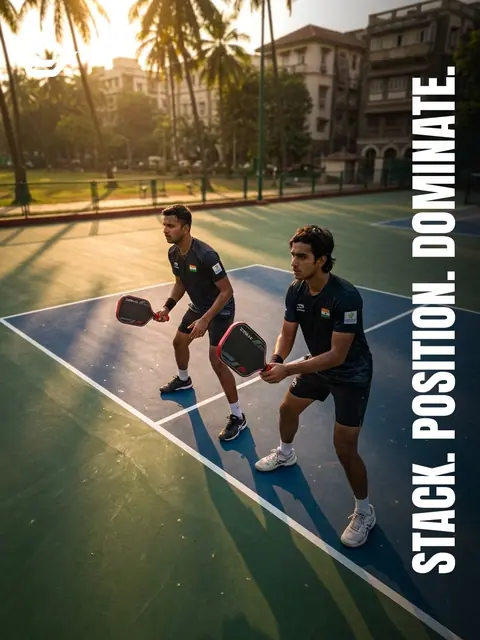
As the pickleball scene in India transitions from casual club play to highly competitive tournaments, players are looking for every possible tactical advantage. You have likely seen advanced players—or pros on the PPA Tour—shifting around the court in seemingly confusing patterns before a serve. This isn't random movement; it is a calculated strategy known as stacking.
Stacking is a positioning tactic in doubles pickleball where partners arrange themselves to stay on a preferred side of the court, regardless of who is serving or receiving. While it may look complex at first, mastering the stack can fundamentally change your win rate by ensuring your team's strengths are always maximized.
What is Stacking and Why Should You Use It?
In traditional pickleball positioning, players switch sides of the court whenever their team scores a point. This means you spend roughly 50% of the game on the left (even) side and 50% on the right (odd) side.
Stacking disrupts this traditional flow. It allows a team to keep a specific player on a specific side for the duration of the point. There are three primary reasons why teams choose to stack:
- The Lefty/Righty Advantage: When a left-handed player and a right-handed player pair up, they can stack to ensure both players' forehands are in the center. The 'middle' is where most balls are hit, and having two forehands guarding it is a massive defensive and offensive advantage.
- Protecting a Weakness: If one player has a significantly stronger backhand or is more mobile in the Mastering the Transition Zone, stacking allows them to stay in the position where they can cover more ground.
- Specialized Skill Sets: Some players excel at cross-court Dinking Strategy from the left side, while others prefer the angles available from the right. Stacking lets everyone play to their comfort zone.
How to Stack on the Serve
Stacking on your team's serve is the easiest way to start. Since the serving team must stay behind the baseline until the ball is returned, you have more time to get into position.
Imagine Player A (the server) wants to play the right side, and Player B (their partner) wants to play the left side. If it is Player A's turn to serve from the left court, Player B will stand just off the court to the left of Player A. As soon as Player A hits the serve, they move to the right side, and Player B steps onto the left side.
The key here is movement. The server must focus on a deep, reliable serve before scurrying to their intended position. Using a paddle with high stability and control, such as the DYSSC HexCore Pro, is vital here because a poorly placed serve gives the opponent an easy return-of-serve, catching you out of position mid-transition.
How to Stack on the Return of Serve
Stacking on the return is more technically demanding. The person receiving the serve must be the one standing in the correct service box. This cannot be changed.
If you are the receiver but want to play the opposite side, your partner will stand near the kitchen line on your 'target' side. After you hit the return, you must run diagonally to your desired side while your partner holds their ground. This is often called a 'switch.'
This maneuver is risky because it opens up a 'hole' on the court while the receiver is running. To make this work, the receiver must hit a high, deep, and slow return of serve to buy themselves enough time to reach their destination. If the return is short or too fast, the serving team will easily exploit the empty space.
Hand Signals: The Language of the Stack
Communication is the backbone of successful stacking. Because the 'switch' doesn't happen on every single point (depending on the score and who is receiving), partners use hand signals behind their backs to coordinate.
- Closed Fist (Stay): This tells the partner that no switching will occur. Everyone stays on the side they started on for that point.
- Open Palm (Switch): This is the signal to stack. It tells the partner that as soon as the ball is in play, both players will move to their 'preferred' sides.
- The 'Pinky' or Finger Point: Some teams use specific finger signals to indicate where the serve should be directed to better facilitate the move.
The Importance of the Right Equipment
When you stack, you are often moving while the ball is in flight. This requires exceptional 'touch' and the ability to reset the ball if you get caught in a vulnerable spot. The DYSSC HexCore Pro is engineered for exactly this type of tactical play. Its Toray T700 Carbon Fibre face provides the friction needed for precise third-shot drops, which are essential for neutralizing the opponents while you and your partner find your stacked positions.
A paddle that offers a large sweet spot ensures that even if you are slightly off-balance while switching sides, you can still deliver a quality shot that keeps your team in the rally.
Common Mistakes to Avoid
- Forgetting the Score: The most common error in stacking is losing track of which side you are legally supposed to serve or receive from. You must always start the point in the correct box based on the score. Stacking only changes where you go after the ball is hit.
- Poor Return Quality: On a return-of-serve stack, hitting a line-drive return is suicide. You must loft the ball deep to give yourself time to move.
- Ignoring the Opponent: If the opponents notice you are struggling to complete the switch, they will aim for the gap. Be prepared to abandon the stack for a point if the pressure becomes too high.
Conclusion
Stacking is a hallmark of an intermediate player moving toward an advanced level. It requires chemistry, clear communication, and a deep understanding of court geometry. Start by practicing the 'Serve Stack' with your regular partner, and once that feels like second nature, move on to the 'Return Stack.'
By playing from your strongest side every time, you remove variables and force your opponents to play your game. Pair this strategy with a high-performance paddle like the HexCore Pro, and you’ll find yourself controlling the pace of the match with ease.
Frequently asked questions
Is stacking legal in pickleball?
Yes, stacking is 100% legal. The only rules are that the correct server must serve the ball and the correct receiver must return it. Once the ball is struck, players can move anywhere on their side of the net.
Do I need to stack in every game?
No. Stacking is a choice. Most recreational players do not stack. It is primarily used when a team has a lefty/righty combination or a significant difference in player mobility or skill on a specific side.
What is 'Half Stacking'?
Half stacking is when a team only stacks during their own serve and plays traditional positions when receiving the serve. This is often easier for beginners to learn first.
Keep reading
Comments (0)
Be the first to comment.