
The Two-Handed Backhand Drive: Pickleball's Hardest Shot to Read
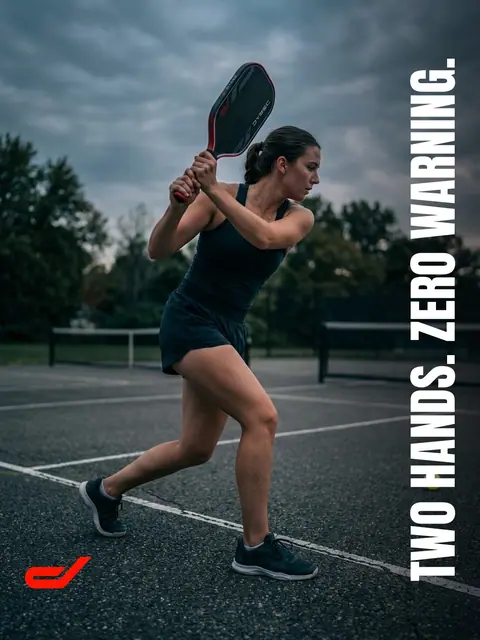
Watch any high-level pickleball match closely and you will notice something: the players who consistently beat better opponents almost always own one shot the rest of the field cannot handle. More often than not, that shot is the two-handed backhand drive.
It is not flashy. It does not look like an Erne. But it is the single hardest ball to judge in the sport, because the paddle face is hidden behind the body until the very last instant, and the second hand lets a player change pace, spin and direction after the opponent has already committed. Own this shot and you stop being a player who returns balls. You become a player who dictates.
Why Two Hands Beat One
A one-handed backhand drive relies almost entirely on shoulder rotation and forearm strength. It works, but it has three structural weaknesses: it leaks pace against heavy balls, it struggles to generate topspin above shoulder height, and it telegraphs. Opponents can read the take-back and the face angle from across the court.
The two-handed version fixes all three:
- The non-dominant hand becomes the engine. Your left hand (for right-handers) pulls the paddle through the ball like a forehand. You are effectively hitting a left-handed forehand with support, which is why the shot generates so much more racquet-head speed.
- The face stays closed longer. Two hands keep the paddle stable through contact, so you can brush up aggressively for topspin without the face flaring open.
- Disguise is built in. The compact take-back for a two-handed drive is nearly identical to the take-back for a backhand roll dinks or a backhand reset. Your opponent cannot tell which is coming until the ball has left your paddle. That half-second of hesitation is the entire game.
That last point is what the owner of this brand means by "harder for opponents to judge the pace and drift." A two-handed drive with heavy topspin dips late and kicks forward off the bounce. Defenders who read it as a flat drive volley it long. Defenders who read it as a dink get jammed at the hip. Both errors are free points for you.
Building the Shot: Grip, Stance, Contact
Grip. Bottom hand in a continental grip, top hand in an eastern forehand grip stacked directly above it, with the hands touching. Do not leave a gap. If your top hand slides too far up the throat you lose leverage; if it sits too low you lose the pull.
Stance. Slightly closed, shoulders turned so your opponent sees your back shoulder. Weight loads on the back foot and transfers forward through contact. Most Indian club players hit backhands standing square and end up arming the ball. The turn is non-negotiable.
Take-back. Short. The paddle head drops below the ball, roughly to knee height, with the butt cap pointing at the net. Long, loopy take-backs get exposed in fast exchanges.
Contact. Out in front of your front hip, never beside your body. The top hand pulls, the bottom hand guides. Finish with the paddle over your dominant shoulder, both hands still on the handle.
Brush, don't push. Low-to-high path at roughly 45 degrees. This is what creates the drift and the late dip. If you need help with the mechanics of spin generation, read our guide on how to add more spin in pickleball alongside this.
When to Actually Use It
The two-handed drive is a weapon, not a default. Deploy it in four specific situations:
- Third shot drive against opponents who are slow to close the kitchen line, then transition in behind it. This pairs with, rather than replaces, the third-shot drop.
- Return of serve when you want to push the serving team deep and buy yourself time to reach the line.
- Speed-up from the kitchen on any ball that floats above net height. This is where the shot wins the most points at 4.0 and above.
- Passing shot in singles against a player camped at the line.
Do not drive from below the net. Do not drive when you are off balance. Discipline is what separates a weapon from a liability.
Three Drills That Actually Build It
- Wall topspin reps. Stand three metres from a wall and hit 100 two-handed backhands with exaggerated low-to-high brush. Aim for a consistent contact height. Volume builds the pattern.
- Drop-feed cross-court drive. Partner feeds a bounce to your backhand from the opposite baseline. Drive cross-court, aiming to land the ball between the kitchen line and mid-court. Ten sets of ten.
- Dink-to-drive disguise. Dink cross-court with your partner. On a random count, speed the ball up with the two-handed drive from the same set-up. This is the drill that trains disguise, and it is the one almost nobody does. For a wider practice structure, our pickleball drills to improve fast piece is a good companion.
The Equipment Factor
Two-handed players need different specs than one-handers. You want a slightly longer handle, ideally 5.25 inches or more, so both hands fit comfortably without your top hand riding onto the face. You also want a stable, low-twistweight-error face that will not deflect when you swing hard off-centre.
This is exactly why the DYSSC HexCore Pro is built with an elongated handle and a raw carbon-fibre face: the extended grip gives two-handed players full leverage, while the thermoformed core keeps the paddle from twisting on aggressive topspin swings. If you are still shortlisting, our breakdown of the best pickleball paddle in India covers how handle length and swingweight interact for drive-heavy games.
Common Mistakes to Fix
- Gripping too tightly. Death grip kills racquet-head speed. Hold at 4 out of 10 until contact.
- Swinging with the arms only. Rotate the torso. The arms follow.
- Hitting flat. Flat drives sail. Topspin drives dip and stay in.
- Reaching too wide. Two hands limit your reach. Learn to release the top hand on wide balls and switch to one hand.
Why This Matters in India Right Now
The standard of play across the country is rising fast, and the courts in Mumbai, Bengaluru and Delhi now regularly host players who can handle a flat drive without blinking. As the level of pickleball in India climbs, the shots that separate players are the ones that are hard to read, not just hard to hit.
Give it eight weeks of honest reps. The two-handed backhand drive is genuinely hard to perfect, which is precisely why so few players at your local court have one. Build it, and you will beat people who are technically better than you everywhere else on the court.
Frequently asked questions
Should beginners learn the one-handed or two-handed backhand first?
Learn the one-handed backhand first for dinks, blocks and resets, since reach and touch matter more there. Add the two-handed drive once your kitchen game is stable, usually around the 3.0 to 3.5 level.
Does a two-handed backhand need a special paddle?
Not special, but handle length matters. Look for a handle of at least 5.25 inches so both hands fit comfortably below the paddle face. Elongated paddles like the DYSSC HexCore Pro are generally better suited to two-handed players than short-handle wide-body shapes.
Keep reading
Comments (0)
Be the first to comment.