
Pickleball Paddle Balance Point: Head-Heavy vs. Head-Light Explained
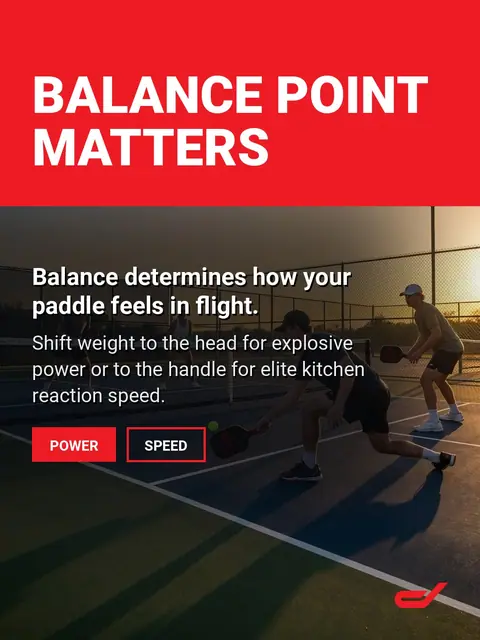
When players shop for a new paddle, they almost always look at the static weight first. They see a range of 7.8 to 8.2 ounces and assume they know exactly how that paddle will feel. However, weight is only half of the story. The other half—and arguably the more important factor for your performance—is the balance point.
Two paddles can weigh exactly 8.0 ounces, yet one can feel sluggish and powerful while the other feels light and lightning-fast. This is not a trick of the mind; it is physics. Understanding weight distribution is the key to finding the best pickleball paddle in India that actually complements your specific mechanics.
What is a Pickleball Paddle Balance Point?
The balance point is the specific location on a paddle where the weight is perfectly distributed between the head and the handle. If you were to balance the paddle horizontally on your finger, the point where it stays level is the center of gravity.
In the world of premium gear, this is usually measured in centimeters or inches from the bottom of the end cap. A paddle with a balance point further away from the handle is considered head-heavy, while a point closer to the handle is head-light. This distribution fundamentally changes your swing weight and twist weight, altering how the paddle behaves during a rally.
Head-Heavy Paddles: The Powerhouse Choice
A head-heavy paddle has more of its mass concentrated toward the top of the face. This design is favored by aggressive players who live for the drive and the overhead smash.
Pros of Head-Heavy Balance:
- Increased Leverage: Because the mass is further from your hand, the paddle generates more kinetic energy at the point of impact.
- Enhanced Stability: More weight in the head helps the paddle resist twisting on off-center hits, effectively expanding the perceived sweet spot.
- Deeper Drives: You don't have to swing as hard to get the ball to the baseline, which is a major advantage for singles players.
Cons of Head-Heavy Balance:
- Slower Hands: In quick kitchen exchanges, a head-heavy paddle can feel "draggy," making it harder to react to high-speed volleys.
- Increased Fatigue: The extra leverage puts more strain on the wrist and forearm, which can be a concern if you are prone to pickleball elbow.
Head-Light Paddles: The Kitchen Specialist
Head-light paddles have their weight concentrated toward the handle and the throat. This setup is the gold standard for doubles players who prioritize dinking and fast-twitch resets.
Pros of Head-Light Balance:
- Maneuverability: These paddles feel "whippy." You can transition from a backhand to a forehand volley in milliseconds.
- Control and Touch: With the weight closer to your hand, you have a better sensory connection to the ball, making delicate drop shots easier to execute.
- Reduced Strain: Because the weight isn't pulling on your wrist, you can play longer sessions with less physical wear and tear.
Cons of Head-Light Balance:
- Lack of Natural Power: You have to generate more of your own swing speed to put pace on the ball.
- Stability Issues: Without mass at the tip, the paddle may vibrate more when you hit the ball outside the pickleball sweet spot.
Even-Balanced Paddles: The All-Rounder
For the majority of players, an even-balanced paddle provides the best of both worlds. It offers enough mass to drive the ball through the court while remaining fast enough to defend against a "banger."
The DYSSC HexCore Pro is specifically engineered with this versatility in mind. By utilizing a thermoformed unibody construction, we ensure the weight is distributed to provide a stable, mid-range balance point. This allows Indian players to compete at a high level whether they are playing a slow, tactical dinking game or an aggressive, power-based style.
How Balance Point Affects Your Game in India
The environment of pickleball in India often involves high temperatures and hard outdoor courts. In extreme heat, pickleballs can become softer and less bouncy. A head-heavy paddle can help counteract this by providing the extra "oomph" needed to push a soft ball deep into the opponent's court.
Conversely, if you play mostly indoors on fast surfaces, a head-light or even-balanced paddle is often superior to help you survive the rapid-fire hand battles that define high-level play.
Which Balance is Right for You?
Choosing a balance point isn't just about following the pros; it's about evaluating your own strengths and weaknesses. Ask yourself these three questions:
- Do I struggle to finish points? If your drives are landing short or your overheads aren't ending rallies, look for a more head-heavy balance.
- Am I losing hand battles at the net? If you feel like your paddle is always a second too late, switch to a head-light setup.
- Do I have joint pain? If your wrist or elbow hurts after two games, a head-light paddle or an even-balanced paddle like the HexCore Pro will reduce the torque on your joints.
How to Test Your Paddle's Balance
You don't need laboratory equipment to find your paddle's balance point. Simply take a ruler and place it on a flat table. Lay your paddle across the ruler and slide it back and forth until it balances perfectly without tipping. Mark that spot. If that mark is closer to the head than the halfway point of the paddle's total length, you are playing with a head-heavy weapon.
Understanding these nuances is what separates a recreational player from a true student of the game. For more advice on gear selection, check out our India buyer's guide to find the perfect fit for your game.
Frequently asked questions
Can I change the balance point of my existing paddle?
Yes, you can use lead tape. Adding tape to the top of the head makes it more head-heavy (more power), while adding it to the throat or handle makes it more head-light (more stability/speed).
Does a head-heavy paddle cause tennis elbow?
It can. Because a head-heavy paddle has a higher swing weight, it requires more effort from your wrist and forearm muscles to accelerate and stop the paddle, which may increase strain.
What is the standard balance point for most paddles?
Most standard 16-inch paddles have a balance point between 8 and 9 inches from the bottom of the handle. Anything above 9 inches is typically considered head-heavy.
Keep reading


Comments (0)
Be the first to comment.